Are YOU ready for the LAUNCH PARTY??

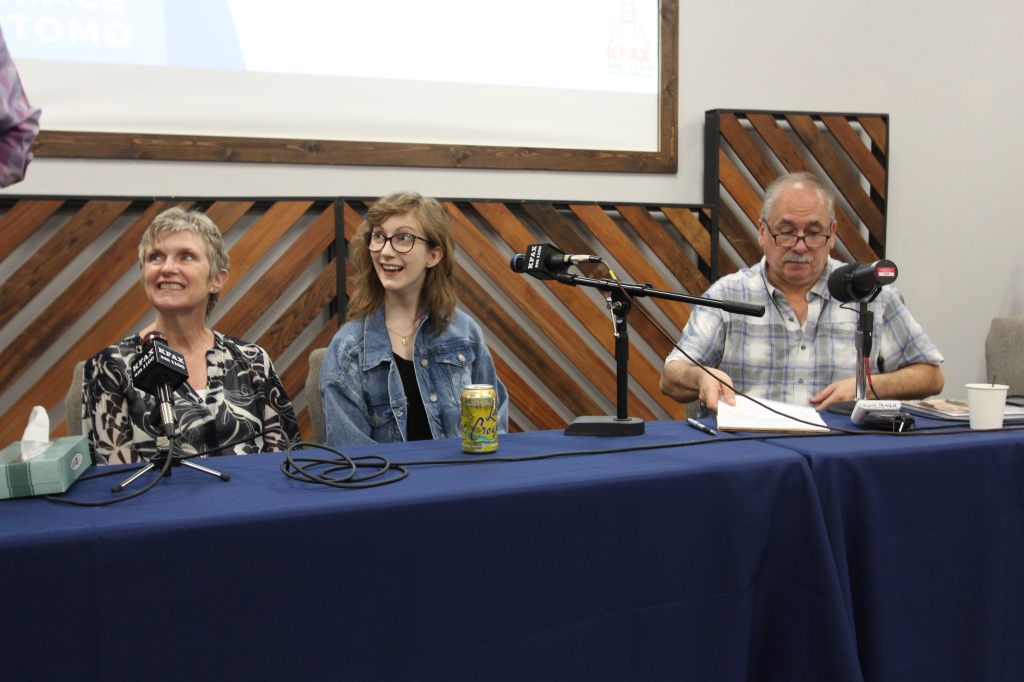
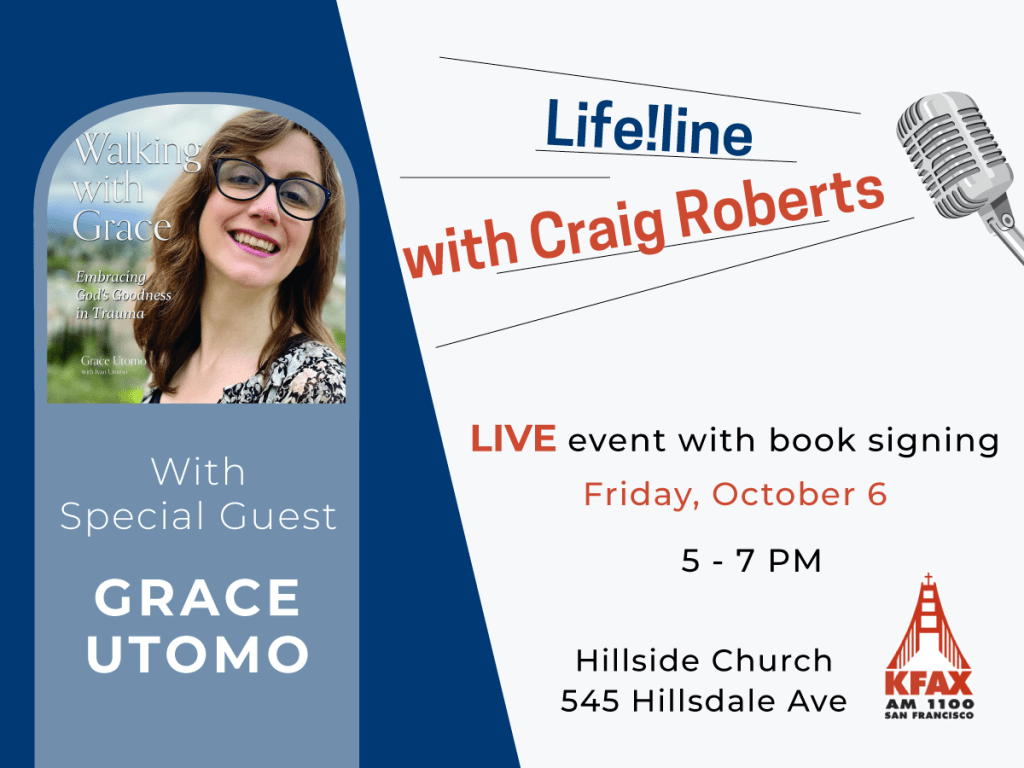
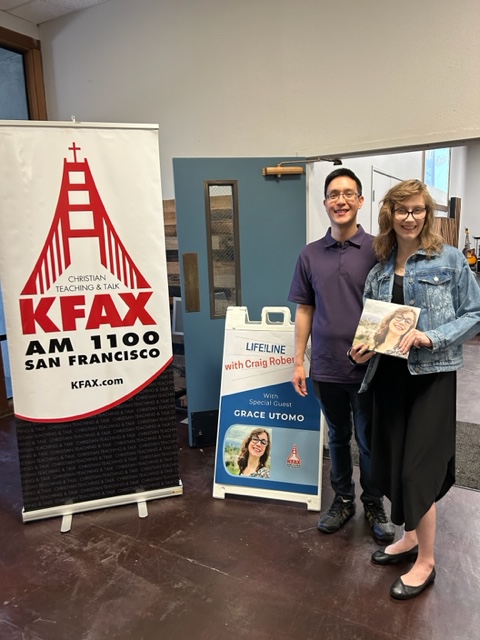
Join me, Ivan, and my parents (Keith and Teri Crosby) at Hillside Church TOMORROW, 10/6, for our live radio interview with Craig Roberts.

“Life!line with Craig Roberts” is Northern California’s longest-running Conservative & Christian talk show.đŸ€­ Show runs 5-7pm PST on KFAX-AM1100.
Latecomers are welcome. Book signing to follow.

Audio stream from ANYWHERE at: https://kfax.com

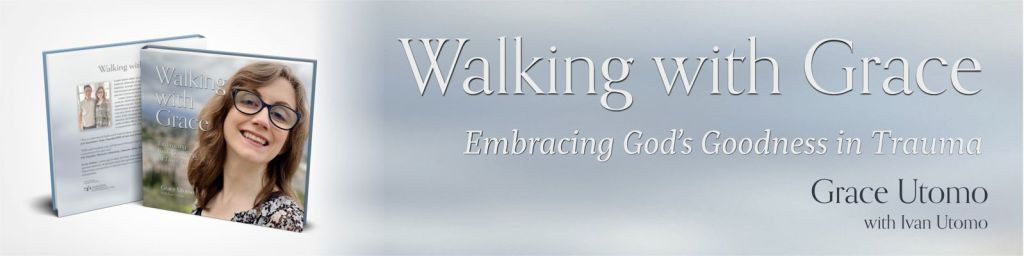
Ivan and I are beyond blessed by the outpouring of messages, comments, likes, reposts, and tags you’ve showered on us over the birth week of Walking with Grace: Embracing God’s Goodness in Trauma. At the risk of sounding like a broken record, whatever you may find encouraging or challenging in our story is a direct result of how graciously God works through and in spite of human brokenness.

Thank you for rejoicing with us at the completion of a work that was first imagined almost seven years ago. ❀ We can’t wait to celebrate with you tomorrow in person, online, and over the airwaves! (KFAX-AM1100)

The Great Reveal!

Happy Friday, Blogging Family! Can you believe it’s T-3 days until Walking with Grace: Embracing God’s Goodness in Trauma comes out this Monday?

Watch my unedited first look at the final copy and praise God with us for the work He has done!

ICYMI :)

Hello Blogging Family! We recently released a video to promote Walking with Grace on Facebook and Instagram so I thought I’d include it here as well.


Your love and support mean the world to us, whatever form that takes. I wish I could write a personal thank youth everyone who reads or shares our story, but I don’t get to see anything about sales. Still, I’ll happily give an enormous THANK YOU if you let me know virtually or in person. 🙂

In the big picture, we hope our story might glorify God by telling of his wondrous intervention and grace in our lives in the midst of suffering. God’s already given you an active roll in that drama and I’m sure will continue to do so. Thank you for how much you pray for us all these years later, and praise the Lord!

Eight on 9/11

Will there be a yesterday? My sister and I are in our bedroom, mulling over the various worksheets covering our “children’s table,” when we hear the phone. But the phone never rings! Daddy is always in class or at one of his jobs, and Mom almost never talks on the phone. Who is it?

Mom leaves us to our assignments and answers in the hallway. She greets our grandmother, “Gi”, but calls my name a few seconds later. “Grace,” she orders. “Turn on the TV.” “Coming!” I holler, vigorously slapping all the limbs that have fallen asleep since I’ve been lying on them. I amble into the living room and turn on our TV, not expecting to see much. We don’t have cable and only pick up a local network or two with our wire set of “rabbit ears.”

What I see as the screen fades into focus on the screen strikes me like a cement battering ram. Planes flying into skyscrapers. Bodies and body parts falling through the air. Fires in the planes. Fires in the towers. And then the unimaginable. Is this some sort of movie? Who’s going to make it stop?

I freeze.

Anna wanders into the living room casually, carrying her worksheet and a few colored pencils.

“What’s that?” she asks. “A plane accident?”

No words.

I don’t remember when Mom hangs up the phone, or what she tells us the day of the attacks. I just remember crouching on our well-used Persian rug, glued to the TV, watching the planes destroy the towers and our people over and over again. It’s like a pernicious Infomercial with ratings that stay so high it never stops. I don’t know why Anna and I keep watching or why Mom keeps letting us. Maybe she’s hoping for more news updates. Maybe the news is indeed updating but my eight- year-old brain doesn’t follow.

Once Daddy gets home I start hearing new, unfriendly words like “terrorist,” “terror attack,” and “Al-Qaeda.” I have no idea what any of them mean. “Mom, what’s a terrorist?” I’ll ask the next day at lunch. She won’t answer.

My violin lesson and orchestra rehearsal are canceled the day of the attacks. As an eight-year-old, this seems perhaps the greatest tragedy of them all. My violin teacher and my orchestra friends are very real to me. I feel happy or sad with them because we share our stories together. These plane attacks are different. I know I should feel sorry for the falling bodies on our pixelated screen. If you asked me if I feel sorry for them, I’d give a resounding “Yes!” But I worry I’m lying. I don’t feel anything on the inside about all those people. Of course I wish they could come back to life and return to their families. But my life hasn’t changed. I’m sick of watching the news and I haven’t had a violin lesson in two whole weeks! Can’t we just pretend like all this never happened and go back to normal?

Our church holds a candlelight vigil the Friday after 9/11. Suddenly I’m holding a real candle in my real hand for another real person who is really dead. That’s about as real as my music lessons. As are the yellow ribbons tied proudly around many trees in our formerly less-than patriotic Van Nuys neighborhood. If those didn’t make 9/11 real to a little girl in the San Fernando Valley, our next flight to Savannah certainly did: Mom, worrying some or all of us will get foot warts as we remove our shoes and walk barefoot through the TSA scanner; me, getting frisked by big, scary officers even though I’m only nine years old; all of us, inconsolable upon learning there are no more in-flight meals.

Even at that young age, I could sense the world was changing and there would be no going back. For a couple of years, our country enjoyed a deeper sense of unity. In some states it even became cool to say pseudo-Christian phrases like “God Bless America.” Twenty years later, I also look at the little children in airports think how sad it must be that they’ll never see a loved one waiting for them right at the gate after they land. What must it be like to grow up always associating planes with impractical precautions, scary what-ifs, and potential death? How did “terrorist” become a vocabulary word elementary school kids acquire and use, just like “clown” or “chef”?

If I were remembering today without Christ, I would see it as a day of utter tragedy for our nation and for the innocent future generations of America. But because I know that God is as completely good as he is sovereign, I can still trust his plan for our country and its families:

29 Then his disciples said…” Now we understand that you know everything, and there’s no need to question you. From this we believe that you came from God.”

31 Jesus asked, â€œDo you finally believe? …33 I have told you all this so that you may have peace in me. Here on earth you will have many trials and sorrows. But take heart, because I have overcome the world.” ~John 16:29-33

In the Hands of the Lord

Happy September, Blogging Family! It’s crazy that Ivan‘s last post was six weeks ago. Hopefully we will clarify that shortly!

I could begin with a variety of jokes about hands, mine in particular, but I’d rather start by quoting the apostle James:

13 Look here, you who say, “Today or tomorrow we are going to a certain town and will stay there a year. We will do business there and make a profit.” 14 How do you know what your life will be like tomorrow? Your life is like the morning fog—it’s here a little while, then it’s gone. 15 What you ought to say is, “If the Lord wants us to, we will live and do this or that.” 16 Otherwise you are boasting about your own pretentious plans, and all such boasting is evil. ~ James 4:13-15

Basically, that’s why I haven’t written y’all earlier. And I’m still not writing. I’m dictating a note on my iPhone. Sadly, Microsoft Word no longer dictates if you are one of those dinosaurs who actually bought the software several years ago as I did. Little could I have known that now you only get the dictation feature if you to subscribe to Office 365. So here we are: Future you, reading. Current me, talking into my phone and sounding like a crazy person to the landscaper near our screen door, knowing that I will still have to email this to myself and correct a bunch of crazy words and punctuation. Alas forsooth.

Returning to our main topic (hands), along with James’s commentary. The aforementioned surgery did what it was supposed to: It released some tendons that had been pressed together in my right wrist. But I was not a good patient. I was supposed to completely rest my right hand for at least 2 to 4 weeks after the surgery. For me, that was impossible. After the two strokes during my initial accident, I never regained feeling in my left hand, which means I’m still overly reliant on my right hand. Take that hand away, and I’m pretty much done for.

Praise the Lord, that the surgery happened in the summer so Ivan was on break and able to help me as much as possible. He was amazingly kind about taking care of chores, cooking, and all the random things that you never think of doing until you can’t. Like using utensils, or lifting a coffee cup (still can’t!), or putting toothpaste on a toothbrush. On my end, I began pushing post-surgical precautions after a few days because I felt guilty sitting around aimlessly, watching my strong, godly husband work like a housewife. What’s more, I hated the idea of him continuing to help me with my responsibilities if I was not completely better before the school year started, (See my plan to go to “a certain town”?)

I was not completely better when he got back to work, and I insisted on resuming as much of my old routine as possible (do business and make a profit). Hence why I am writing to you today. To summarize complicated medicalese, the surgery site healed as planned, but I’ve overcompensated while it was recovering with other parts of my right hand so that these parts are even more painful than the original injury was. My right hand has built up so much scar tissue and inflammation that it’s simulating pretty noticeable arthritis. Since I haven’t had this problem before, they’re not treating it as real arthritis, and they’re hoping it will settle down with lots of therapy. Until then, I have a giant red X marked over handwriting, typing, and therefore most of my academic/creative life.

Giving both my hands to the Lord is terrifying. God chose not to restore my left hand when he was healing me from my original accident, which means I haven’t performed on the violin since 2016. That loss is something I still grieve deeply. As I continue on this hand journey, I hear a voice of fear whispering, “What if you lose the right hand too? That was your second chance at creativity, at having a meaningful purpose in life.” But this is where I run to God.The voice in my head is lying. Living as God’s redeemed child is my purpose in life. And he helped me survive an extreme accident, which drives home just how much he wants me here on earth. I’m in his hands even if I don’t know the plan yet. Those fears trying to deceive me are not the guaranteed outcome of this trial with my right hand – they’re just worst-case scenario thinking. My therapist, on the other hand, is so confident he can “fix” me that he put a number on it : 12 sessions.

But even if God wills differently than the therapist, or I “find more “emergencies” to use my right hand; even if the scar tissue doesn’t break down, or the inflammation stays and it does become arthritis, I’m not losing my right hand. I’m sure we’ll find a good dictation set up. I might not be as creative as I’d hoped since I prefer working with pen and paper, but I’ll know that I’m working the way God wants me to work. And I know when I’m doing that, as the line goes in Chariots of Fire, “I feel His pleasure.”

I can’t see what the next four months hold. Perhaps not much writing (unless I can bribe Ivan!). But I know God’s sovereign plan is best for me, and for you, and for all of us who are waving our arms (and hands) wildly, trying to regain our footing after getting our breath knocked out of us by disappointment ninjas. Fall into God’s arms with me. He won’t ever let us go. 

Friendly Reminder: Walking with Grace: Embracing God‘s Goodness in Trauma comes out October 2!! You can pre-order now through Amazon or Shepherd Press.

<3<3Thanks for your prayers and support through all the years! <3<3

“All I Wanted was a BandAid” and other Tales from the Old World.

Good morning, Blogging Family! I’m super excited to be writing an 110 % certified organic blog post this morning. As fun as it is keeping y’all posted on book updates, I sure have missed telling the good ol’ yarn. And what a yarn do I have for you!

Some of you may already know that Ivan and I spent 10 days in London and Paris last month. We were on a “working trip” for Ivan’s school that included 29 highschoolers, three parents, and a couple of other teachers, but I didn’t mind. We were just super grateful I was able to join. That was possible only because the students spent five days in each city. The pace allowed me to join a few excursions but rest at the hotel as much as I needed. Instead of giving a detailed summary of our fortnight in the Old World, I’ve selected a few episodes from my travel journal to give y’all a flavor of the trip:

LONDON: “I really have to make a call, Miss!”

True to the stereotypes of vintage films and fashion magazines, London still has red telephone booths almost every block. A few years ago, I’d heard about a movement demanding they be removed. Obviously no one must use them anymore, I extrapolated in my American omniscience. I felt pretty justified: who would pay to use a dumb phone in the era of AirPods and iWatches? 

Almost every American (girl) who goes to London poses for a picture in one of those red booths. I pulled Ivan away for my shot while the kids were wandering around outside Westminster Abbey. Honestly, it was meant to be a “one and done.” But then there was wind, my bag looked awkward slung across my torso, the noon light insisted on dissecting my face neatly into dissimilar halves. Suddenly a perturbed man’s voice battered its way through the wind. “I really have to make a call, Miss!” I hadn’t even noticed the scruffy man in shorts and a t-shirt leaning against one of the shops. He stormed off down the sidewalk before I could answer.

~

LONDON: The King’s English

Occasionally someone comments on my annoyingly correct grammar here in the U.S. (E.g. “Gift” is not a verb. “Gift” is a noun. You cannot gift someone a present. You must give them the present.) 

Nevertheless, I was on pins and needles when we landed in the U.K. because that was where the real English speakers lived. It didn’t matter how much time I’d spent reading and writing over the course of my life: I was positive my language skills weren’t up to scratch.

Alas forsooth.

Our group stayed in a charming Victorian mansion that had been converted to a small hotel. Ivan and the kids were usually out from 8 am – 9 pm, while I either went out in the morning or the evening. Our second day in the hotel, I thought I’d arrange my schedule so I’d be out of the room during housekeeping hours. I spotted a petite brunette woman in what looked like a housekeeping uniform at the end of the hall:

“Excuse me – what time is housekeeping today?”

“No English.” Her accident was unidentifiable.

“Oh. When – clean – today?”

“No English.” Apparently she wasn’t kidding.

I was completely out of my depth. Ivan and I are functional in Spanish, so we don’t usually have a problem communicating with the majority of non-English-speakers in California. The only other language I’ve studied was French, and I was very sure my new friend wasn’t from France either.

“Translator?” She almost begged.

“Yes please!” I tried smiling to show I wasn’t angry.

A couple of minutes later my dainty friend returned, accompanied by a sturdy, matter-of-fact woman I recognized from the hotel bar. 

“So sorry to bother you!” I began, finally processing just how much trouble I was raising over a simple question. “What time is housekeeping today?” 

The new woman cocked her head to one side and looked at me quizzically.

“No English.”

~

PARIS: All I wanted was a Bandaid


Surprise surprise! Paris was by far my favorite part of the trip, and I would go back again tomorrow if I could. Both Ivan and I had studied French in the past, and we reviewed a bit before the trip with a particular goal in mind: Could we make it all 5 days without speaking English? (This was a personal challenge; most of the kids did not speak French, and our tour guide was bilingual.) 

Most of our group’s excursions were ĂĄ pied or en mĂ©tro, which on average had us walking 6-8 miles in humid, 85Âș F heat each day. (No, we did not experience central air in buildings, trains, or hotels.) With all that sweatiness, I wasn’t terribly surprised to slide off my Crocs one night and discover that my left pinky toe had been skinned as perfectly as you might peel an apple or grate a carrot. In other words, I had toe but no skin. 

Pro travelers would have brought their own bandages. But this was our first trip abroad and I have more important medical needs to remember than a hypothetical Bandaid. Besides, the front desk always has those, right? Then Ivan and I looked at each other.

We were in France.

Did concierges provide anything? There was a pharmacie across the street, but Parisian store hours seemed different from ours, and that place didn’t open until after we would have left for our morning excursion. 

“Can you just make it?”

We looked at my foot. The fleshy, red toe dermis looked like it was pulsing under the bathroom lights.

“I can’t even touch it.” All this, after 10 pm at night. 

I prayed for miraculous restoration, but the Former Toe was even worse the next morning. I told Ivan to go ahead and feed himself. My priority was someone who had anything remotely like a Bandaid. Recognizing that brand names are probably different in Europe, I looked up the word for “bandage” (pansement) and sallied forth. Such cultural awareness could not fail.

“Je suis desolĂ©e, mais j’ai besoin d’un pansement.” I smiled professionally.

“Quoi?” The Saturday morning concierge was lost in something fascinating on her computer.

“Un pansement. J’ai besoin d’un pansement.” I spoke more slowly in case I’d rushed the first time. I’d watched more than enough French movies to know that my grammar and usage was correct.

“DesolĂ©e, mais je ne comprends pas.” 

“Bandage. I need a – ” There was no good hand signal for a Former Toe.  â€œ –  Je peux vous l’áș»crire?” I gestured for a pen and paper. Just then, an older member of the hotel staff approached. 

“Qu’est-ce qu’il se passe ici?” she asked.

“I want a pansement!” I was approaching the end of my rope.

“Un pansement?” the woman smiled, â€œTout de suite!”

I smiled pathetically at the concierge while waiting for my coveted bandage to appear.

“DesolĂ©e, mon français est vraiment mauvais.”  

“Pas du tout! We say ‘pansement.’” She nodded encouragingly, waiting for me to try on my own.

“Pansement.” 

“Pansement – much better!”

I could not for the life of me tell the difference.

~

Are you as excited as we are about Walking with Grace the book? Watch the trailer and preorder your own copy here today!

Watch the Trailer and Preorder!

It’s here! Ivan and I are super blessed to premier Shepherd Press’s trailer for Walking with Grace. And we’re giving you, our Blogging Family, priority viewing! 

Click here or check out the link below to preorder your copy today!

Amazon.com:

Ivan and I couldn’t have made it this far in my physical or our emotional and spiritual journeys without your love and prayers. We remain humbled and blessed by all of you, some of whom we won’t meet until heaven. However you walk with us now or in the future, all of your support is equally precious and undeserved – a pleasing aroma to the Lord. We pray this book brings glory to God and healing to many.

Stay in the Loop!

Hello, Blogging Family! We have some exciting news to share this holiday weekend.

Shepherd Press will be releasing my memoir this October at the national ACBC* conference in Santa Clarita, CA. The book is called Walking with Grace: Embracing God’s Goodness in Trauma, and uses my experience as a survivor of severe traumatic brain injury to examine how we should respond when God doesn’t grant our urgent prayers for healing.

Follow this link if you’d like to be notified when you can pre-order your copy of Walking with Grace.

Thanks as always for your love and support!

*Association of Certified Biblical Counselors

When Covid Comes Calling

Ladies and gentleman, it happened. Neither Ivan nor I tested positive for Covid since the pandemic began – then both of us went down a few days apart at the end of April. This isn’t really noteworthy since everyone seems to have had the virus at least once already.  However, I feel obligated to announce our defeat for the sake of those betting on how much longer we were going to make it Covid-free. 

What I do find noteworthy is looking at what the Bible says about caring for your spouse sacrificially when both of you are sick. God clearly had our upcoming trial in mind when he ordained what sermons Ivan and I would hear and what Scriptures we’d be dwelling on before our Covid downfall: Our church is working through a series on the book of Philippians, and we’d just launched a “Read Philippians” challenge with our small group.  Philippians 2:5-8 was planted firmly every way we turned, a giant billboard with flashing neon letters:

“You must have the same attitude that Christ Jesus had.

Though he was God,
he did not think of equality with God
as something to cling to.
Instead, he gave up his divine privileges;
he took the humble position of a slave
and was born as a human being.
When he appeared in human form,

he humbled himself in obedience to God
and died a criminal’s death on a cross.”

It’s hard enough to emulate Christ’s attitude when a loved one is sick. We all have at least one friend or relative who’s reasonable, lovable, and would never, ever take our slap-in-the-face-obviously sacrificial care for granted. Like all of God’s commands, we need the power of His Holy Spirit to “work out [our] salvation with fear and trembling” (Phil. 2:12) and serve that person without demanding anything in return.

But what if you’re both sick? Does this become an “I’ll scratch your back if you scratch mine?”

[Insert your reaction of choice], no. Paul’s command applies to both partners equally, which means both of them should be equally willing to sacrifice their good for the good of the other. The principle that keeps this from turning into a self-oriented transaction is that each spouse should be motivated by their love for God and desire to obey his commands, not by their partner’s ability or willingness to return the favor. This “God first” mentality ensures God will be glorified, protects us from worshiping ourselves, and also enables us to bless our spouse with the same grace we’ve received in Christ.

And that’s where I must say, “Praise the Lord!” and “Thank you, Ivan!” Ivan’s Covid was uncomfortable and disruptive but not serious. I enjoyed playing “nurse” for a couple of days (to be honest, I didn’t put myself out too much), only to wake up very sick halfway through Ivan’s quarantine. Sparing unseemly details, this was not Ivan’s Covid. At all. Suddenly he was back in his old caregiver role: feed (unsuccessful), bathe, bathroom, laundry. It was like we had rewound our lives five years. I have no idea how he was feeling because all I could think about was me. 

I praise the Lord that Ivan finished his first week back at work relatively strong and we didn’t need to take unpaid leave. But he’s still been doing most of my housework since I’m really struggling with fatigue. Most of all, I praise God for enabling Ivan to care for me the last couple of weeks. We’ve gotten so used to my being fully functional that we were (at least I was) shocked by the amount of work it took just to get through one day. It’s easy for me to sit here theorizing about obedience as I yawn over my coffee. Ivan, however, was faced with the very real choice to “rest up” like he deserved or deny himself by caring for me when I hadn’t earned it. 

 â€œThere is no greater love than to lay down one’s life for one’s friends.” ~John 15:13

Medicine, Miracles – or Both?


This Spring I also turned thirty…

Hello Blogging Family! I hope you all had a blessed Easter and are enjoying a refreshing April! Spring helps re-focus my eyes on God, our Redeemer who creates clean hearts through Jesus’ death and resurrection, and our Creator who treasures the sparrows in their nests and squirrels their hovels. This Spring is particularly meaningful since I’ve just concluded a treatment that began in October 2021. Some of you may remember that I experienced hallucinations and depression starting that Fall, and struggled to overcome them until February 2022. For a variety of reasons, my health care provider enrolled me in a remote therapy program to monitor my mental health for the following year. 

The arguments contrasting secular mental health therapies with Christian alternatives like biblical counseling are quite complex, and I don’t wish to address them in this post. What I do want to talk about is how we Christians think about God and medicine, not snacking on brownies at Bible study, but shivering as we wait for the doctor on one of those systemically uncomfortable exam chairs, or holding our breath before hitting “Log In” to that seemingly unnecessary Zoom appointment.

If there were only one thing I could tell myself back in October 2021, it is that God loves our brains. As Genesis says, “God looked over all he had made, and he saw it was very good!” God could see the future as he admired Adam, his masterpiece. God knew that Adam would fall, that we descendants would get sick and injured, that our brains would deteriorate from dementia and Alzheimer’s, and that we would wreck them ourselves through substance abuse and other addictions. But God still said that this brain he made was very good. 

Not only that, but God completed the Bible centuries before anyone wrote the first psychiatric textbook. If you do a quick “psychiatry” search, you’ll find that Western European scientists didn’t start taking psychiatry seriously until the 19thcentury. Before the 19th century, people often assumed that anyone who had seizures or exhibited abnormal behavior was insane, demon-possessed, or both. But the gospels describe Jesus healing people who were demon-possessed, people who were ill, and people who were epileptic. Jesus’ disciples could tell the difference among the three by around AD 30. If God was so far ahead of us on brain diagnoses, why do we doubt his sufficiency for treatment and healing? 

Perhaps it’s because the Bible doesn’t give step-by-step instructions on what actions to take if your father has a mental breakdown, or your daughter has a seizure, or your mother-in-law has a stroke. Ask any passer-by, on the other hand, and they’ll squint sideways at you, “Call 9-1-1!” 

So how do we integrate trusting God’s power with benefiting from modern medicine? When we look in the Scriptures, we see God use miraculous healing a number of ways. In the Old Testament, he sometimes uses miracles to validate his prophets. One HD example comes from the book of Exodus: God strikes Moses with leprosy, then heals him in the next instant – all to validate Moses has been chosen to deliver Israel. 

In the New Testament, physical healing can also validate salvation. The Gospel of Luke tells the remarkable story of a paralytic who was so determined to be healed that his friends cut a hole in the roof of the house where Jesus was teaching and lowered their disabled friend to the ground right in front of Jesus, mid-sermon. (Talk about distractions!) But Jesus doesn’t heal the paralytic’s body; He just tells the man his sins are forgiven. Jesus only heals him physically after the scribes and Pharisees question Jesus’ power to forgive sins. In other words, “If I can cure the physically disabled, what makes you so sure I can’t heal spiritual outcasts too?”  

The fact that Jesus and the Apostles healed any of the paralyzed or lame instantly has become extremely impressive to me after my accident. Some of you might remember I was not able to put any weight on my legs for the first three months of recovery, and it took another six months of multi-hour, daily therapy to learn how to walk well. In short, once you stop using your legs, you have to spend a whole lot of time practicing carefully before you can use them again. So visualizing former cripples jumping up from their mats, and walking and leaping as they praise God, is miraculous on many levels. Jesus didn’t make them “like new,” he made them better than new.

After Jesus ascends to heaven, the Apostles begin healing “in the name of Jesus” to testify to the reality of his resurrection and to their legitimacy as his ordained leaders. As I think about healing this way, I realize its purpose isn’t to fix all my physical and psychological problems. Its point is to glorify God, and prompt others to consider their relationship with him. Do I want to be healed because that would be extremely cool? Or do I want it because healing me would make God look bigger to those around me? 

So far we’ve been looking at why God heals miraculously, but we can also find specific instances in the Bible where he uses  â€œmodern” medicine to heal people. In the book of Isaiah, we read of King Hezekiah getting sick to the point of death. Suddenly the prophet Isaiah shows up with a message from God – and a recipe for a poultice that heals Hezekiah almost instantly. 

In the New Testament, the Apostle Paul suggests a home remedy for Timothy’s stomach troubles. James commands church elders to anoint sick congregation members with oil as they pray over them. Today we associate oil with sacred practices, but in ancient times it was also used in many medical cures. Perhaps James is describing a both/and approach: consecrate the sufferer to the Lord first, then pursue whatever treatment is available.

Is there a conclusion to work together from these varicolored yarns? As I said at the beginning of the post, my goal was not to argue for or against psychiatry, or any other kind of medical treatment. My goal was to look to the Bible as a primary source and see what I could find on healing, miracles, and medicine. The controversy surrounding those topics is so loud – even in Christian circles – that I’ve never spent much time looking into them myself. I admit that I did cherrypick specific vignettes to support my points –this post is too long as it is – and I realize many might disagree with me. 

For those of you who’ve walked with me all the way to the end of this post, thank you for your patience! I hope God will continue working in all our lives so that He grows bigger and we grow smaller. Praise God for the wisdom found in his Word, which is more than enough to sustain us in every situation, whether physical or spiritual.

“By his divine power, God has given us everything we need for living a godly life. We have received all of this by coming to know him, the one who called us to himself by means of his marvelous glory and excellence.” ~ 2 Peter 1:3