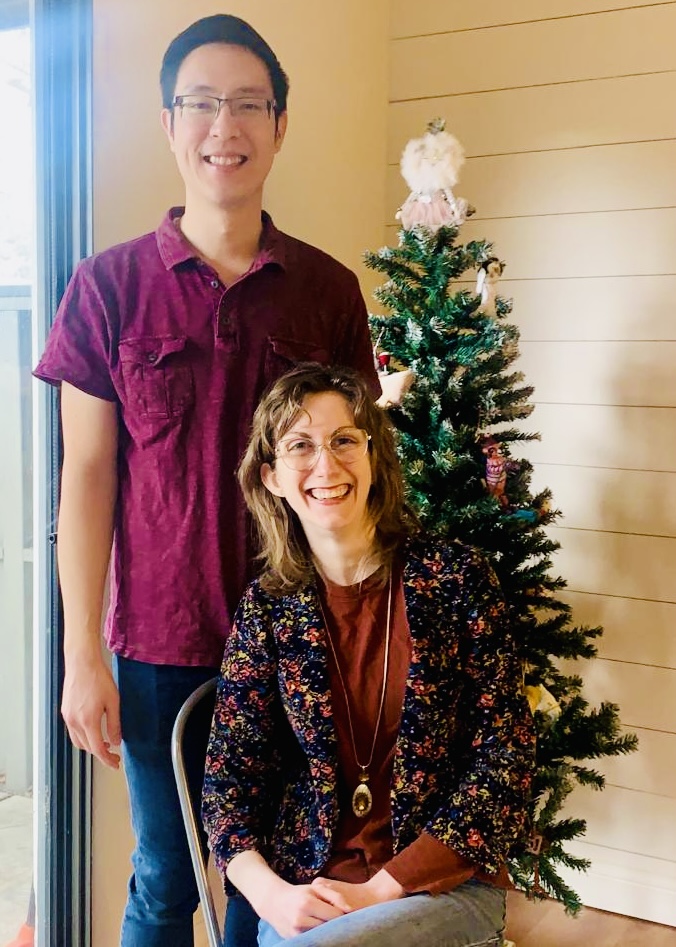
Yesterday was my 33rd birthday; thank you so much to everyone who sent birthday wishes! This birthday felt especially meaningful, perhaps because our Lord Jesus was 33 years old when He went to the cross to pay for our sins. Lord, may You be glorified through me this year.
Internally, I still feel like I’m around 23 years old instead of 33. Yet at the same time, so much has happened in the past 10 years that I unquestionably also feel much “older,” although I suspect that “future me” may also find this comical.
Time is a strange thing, isn’t it? Especially when we consider the perspective of God, who created time in the first place. Peter famously said, “But do not overlook this one fact, beloved, that with the Lord one day is as a thousand years, and a thousand years as one day” (2 Peter 3:8).
God has been with me every day of the past 33 years of my life; even if I had been born 330 or 3300 years ago, His sovereignty and goodness would remain unchanged. And my hope throughout life is that God is calling me home to be with Him and enjoy Him forever in the life to come. When I’m tempted to think of myself as the main character of “my story,” God’s Word reminds me that He is the main character of history, and He has invited me (and all of us) to play a part in His redemptive story.
I’d like to end by sharing that yesterday I felt God impress this verse on my heart as a key verse for this next year of my life:
“For God gave us a spirit not of fear but of power and love and self-control.”
2 Timothy 1:7
When we find ourselves facing fear, or any of its companions – worry, anxiety, discouragement, doubt – may we cling to the God who is the source of power, love, and self-control. For those of us who have placed our faith in Christ, He is transforming our hearts from the inside out so that day by day we resemble Him more, radiating His light and love to those around us, for His glory. May we fear Him above all else, trusting in His unchanging love, mercy and grace.
Throwback to our time in Austria this past summer! These are the steps from the “Do-Re-Mi” song from the movie, “The Sound of Music.”
One of the bright spots I can count on every December is Ivan’s birthday! I’m so grateful we’ve gotten to celebrate quite a few together at this point. He asked me to start praying about dating the day before his 21st birthday, and today he turns 33! If the Lord is pleased to grant us both continued health and safety, then we have many more to look forward to together.
It’s been such a privilege walking alongside Ivan throughout our twenties and now into our thirties. Early in our marriage, almost all of his time and energy was devoted to caring for my physical health, but as God has graciously removed some of those burdens, it’s been exciting to see him growing in areas that were put on hold, or he hadn’t yet explored. This past year, I’ve been grateful to see him grow in leading worship (he’s always been a gifted pianist, but developing in leadership is exciting), as well as joining me in prayer ministry and interceding for others. I’m so grateful that God in His perfect wisdom chose us to journey through life together, and I can’t wait to see how He will continue to work in Ivan’s life in the coming years.
And it is my prayer that your love may abound more and more, with knowledge and all discernment, so that you may approve what is excellent, and so be pure and blameless for the day of Christ, filled with the fruit of righteousness that comes through Jesus Christ, to the glory and praise of God.
I’m grateful to my parents for instilling in me the importance of memorizing Scripture at a young age. They enrolled me in AWANA when I was five, shortly after we moved to California for my dad to attend seminary, and I stayed enrolled until we moved Wisconsin (5th grade). If you’re not familiar with the program, it teaches children to memorize and understand Bible verses in a fun, age-appropriate environment. I can still recite many of the verses I learned during those years, so I am proof that God can use these programs throughout children’s lives to strengthen, encourage, and comfort them.
Later, while I was studying violin in New York, a dear friend and I memorized the entire book of 1 John together. This endeavor reminded us what it meant to walk in the light and be a child of God in an environment where it was very challenging and unpopular to be a Christian. Ivan and I continued this trajectory while we were dating by memorizing Philippians and Colossians.
After my accident, Scripture memory has become A LOT more difficult. I originally thought it was impossible, but over the years the Lord challenged this assumption by revealing how many of the verses I memorized long ago are stored in long-term memory. I’ve realized that Scripture memory is still possible – it just requires significantly more time and repetition. Recently, my discipleship group has been memorizing Psalm 46 at the rate of 1 verse per week. This is the perfect pace for me, and I’m so grateful for how the Lord has been using each verse as timely encouragement.
This post also brings up the question of why memorize Scripture in the first place? My favorite answer is found in Psalm 119:11:
“I have stored up your word in my heart, that I might not sin against you.”
Memorizing Scripture makes us more familiar with what God has told us about himself in his Word, which will grow both our capacity for worship and our gratitude for his amazing gift of salvation. It will also empower us in our ongoing battle against sin and temptation. I’m struck by the fact that even Jesus, when he was tempted by Satan in the wilderness, chose to resist by quoting Scripture rather than unleashing divine power. Perhaps that was an example for all of us who are not the Son of God, but are nonetheless called to both imitate his example and trust that he can empathize with us in our weaknesses (1 Peter 2:21; Heb. 4:15).
My prayer is that, whether you’ve been memorizing Scripture for a lifetime or are just starting out, this testimony will encourage you as you continue on your journey.
In our December 3rd post, I mentioned that my 5-year journal helps me track God’s faithfulness in our lives over time. A big, recent demonstration of God’s grace has been my relearning to drive over the past year. (Thank you so much to everyone who has persevered with me in the process, and continues to accommodate our status as a one-car family!)
After commemorating this major transformation Wednesday morning, later that afternoon my skills in both driving and trusting God were significantly tested. As I’ve written previously, due to the brain injury, I’m totally reliant on my GPS to navigate. I’m specifically dependent the audio function because, with my visuospatial deficits, it’s not safe for me to glance from the road to the screen to check for upcoming directions.
But Wednesday, just as I got on the freeway, the audio on my GPS cut off (although my phone continued navigating). All I could think to do at 65 + mph was to exhort Siri, “Turn audio back on!” To which Siri calmly replied, “Your phone is not on mute. There is nothing playing.” This was obviously untrue, but after repeating our exchange several times within a two-minute period, I decided I was going to have to either remember how to get home on my own, start checking the phone screen for directions, or both.
As I’m writing this post, I’ve identified a third solution, which I’m sure many of you have also noticed: I should have pulled over to see what was wrong with the phone. However, part of my residual TBI deficits can prevent me from thinking clearly when I’m upset. Therefore, this most obvious solution did not occur to me at the time. And this is also why I’m so grateful that God enabled me not to panic while I was on the freeway.
Given this bizarre turn of events, it took me significantly longer to get home: 20 minutes turned into 45, and I ended up on a couple of freeways that I definitely should not have. But I was also surprised by how much of the general geography of San Jose I’ve absorbed by osmosis in the last year. And I believe the fact that I remained peaceful until I reached home was God’s supernatural intervention.
When I did get inside and examine my phone, I discovered the audio had cut off because it had switched into night mode/do not disturb. I’ve set my phone to do this from 10 pm – 6 am on weekdays, but there’s not a good objective explanation for why it would switch to this mode on its own around 12:30 pm on a sunny day.
What I can say objectively is that we’ve committed to give God thanks and praise every day until Christmas, and by his grace even this scary incident has transformed into a wonderful reminder of how the Lord is always with me and, when needed, can empower me to do things that usually lie outside my abilities.
This Christmas, Ivan and I are starting each day by listening to a Christmas song on Spotify and reading two Christmas carols from our hymnal. (We’re reading two a day because we’d like to make it through the entire repertoire by Christmas). This has reminded me just how transformative it can be to start the day with praise as well as prayer and Bible reading. It’s also been delightful to juxtapose old favorites with contemporary Christmas songs. We’re making some wonderful discoveries!
I wanted to share this song with you today because I feel it captures a raw, human element of the Nativity scene that can be easy to gloss over. While it’s true that none of us knows for sure what Mary and Joseph’s actual experience was like, I think good art gives us space to highlight both certainties and possibilities for the sake of appreciating truth more deeply.
Based on what Mary and Joseph were told – Jesus was God’s own Son – as well as what they were not told – how they would raise such a miraculous child after his apparently “scandalous” conception – they likely experienced a degree of uncertainty along with awe and wonder at His birth. I think this song is a beautiful depiction of this possibility, and also an encouragement to us today that, aside from Jesus, who was God in human form, the Lord has always used finite humans to accomplish His redemptive work.
This is my favorite picture from the rehab hospital!
Ivan: Nine years ago today, I almost lost my wife. And nine years ago, God showed incredible mercy and grace to me and Grace. It’s still hard for me to capture in words what these past nine years have been like for me—what they’ve felt like. To say that they have been “challenging” seems a gross understatement; and yet, I’ve also never felt more keenly the presence and power of God. He is the Everlasting One, the Creator of all things, who had written down in His book every single day of my and Grace’s lives before we were even born. And He has proven Himself more than faithful, lavishing grace upon grace to us, walking with us every moment of every day. He has taught me so much about Himself, and about who I am before Him—who He created me to be. Through every sorrow and difficulty that these nine years have brought, God has been impressing more and more upon my heart the beauty of this truth: that He is “the strength of my heart and my portion forever” (Psalm 73:26). There is no greater joy in this life or the next than to walk closely with the God who created you; to worship Him and delight in His goodness, wisdom, and sovereignty. As the prophet Jeremiah famously said:
“The steadfast love of the Lord never ceases; his mercies never come to an end; they are new every morning; great is your faithfulness. ‘The Lord is my portion,’ says my soul, ‘therefore I will hope in him.'”
Lamentations 3:22-24
Grace: As a writer and counselor, I keep many journals simultaneously. One of them is a 5-year journal. It contains 365 pages, with a different prompt for each day of the year, and space on each page to both respond and observe how my responses change over time. I love this journal because it helps me pay attention to how God is working in our lives. As I observe my responses over the past few Decembers – and especially consider how December is not just the month of my initial accident, but has also subsequently been a month where God allows other trials into our lives – I’m impressed by the realization that this is not the only way of describing this season. December has also been the month of some amazing new beginnings and answered prayers. Two years ago, it was the month where I began weaning off seizure medication after we realized I’d been miraculously healed from seizures. Last year, it was the month where I started exploring San Jose after getting my driver’s license back – the fruit of successfully getting off all that seizure medication and waiting the requisite amount of time to demonstrate to doctors and the DMV that my seizures were indeed gone.
So, as we pause to note what has become a sober personal anniversary for our family, it also seems appropriate – and fitting on the heels of yesterday’s post – to note the prayers God has continued answering in our lives, often beginning with small steps of faith. And for these answered prayers we are very grateful.
This is a “small thing” that is part of our Christmas decor. I don’t remember how we got him, but he always makes me smile!
I like statement pieces, bright colors, and big accomplishments. I do not like small starts, slow builds, and gradual pay-offs. But that is why the past nine years have been very good for my soul. We have rarely done things quickly, and although God has worked in our lives very powerfully at times, most of His work – both physically and relationally – has been slow and steady.
Ivan and I read through the Bible every year, and we recently finished Zechariah. One of the verses that stood out to me was Zechariah 4:10 “For whoever has despised the day of small things shall rejoice, and shall see the plumb line in the hand of Zerubbabel. ‘These seven are the eyes of the Lord, which range through the whole earth.'”
It’s a strange verse, and it comes in the context of chapter 4, where Zechariah is receiving visions encouraging Zerubbabel and the people of Israel to continue rebuilding the temple after they’ve return from captivity in Babylon and are facing opposition and discouragement.
While God was certainly speaking to a particular people in a particular context, I think he also included these words as encouragement for all of us. It’s easy to compare small, apparently insignificant days and events with the glorious “finished products” from our past and forget that these also once began as small things. The Jewish people were tempted to despise the less-than-promising beginnings of their second temple when they remembered Solomon’s temple in all its former glory. But even Solomon’s temple was once a construction site. Ironically, it would be this second temple, the “small thing” that they were tempted to denigrate, in which Jesus would one day, walk, talk, and teach. I think perhaps this is why this verse ends with the seemingly unconnected description of the seven eyes of the Lord. God sees so much more than we can possibly see at any given time. He knows the end from the beginning, not just of our lives, but of all history. And what we may incorrectly downplay as a “small thing,” he may rightly value as a cause for great joy, not just for ourselves but for humanity. I hope this can be encouraging, especially if you are in a season of “small things.”
Good morning, Blogging Family! I can’t believe it’s already December. If you’ve been following our blog for a while, you’re aware that December is a pivotal month for Ivan and me. As followers of Jesus, it’s the month we celebrate Christ’s birth and look forward to His second coming. On a positive personal note, it’s also the month that contains Ivan’s birthday and our anniversary. On a less celebratory note, the end of the year also seems to be when we encounter our most significant trials (my original accident, my most serious subsequent hospitalizations, Ivan’s accident, and the delayed publication of Hello, God are a few of the ones we’ve posted online). Because of this trend that’s stayed strikingly consistent over the past decade, this month I feel led to counteract my sense of foreboding by posting each day until Christmas about something we’re grateful for or ways we currently see God working.
This is out of character, as I typically don’t write until I have a clear vision for where the the Lord is leading with a post or project, or until I have a decent amount of time to polish what I’m posting so it’s “most beneficial” to readers. But committing to something like this series removes all the parameters that keep me in control, and also leaves me open to the fearful possibility – what if something else bad does happen? What will I write then? This is a very real possibility. But I believe that should this come to pass, God will provide hope and grace for us in the trial, and committing in advance to give him thanks and praise publicly each day until Christmas has a strong biblical foundation. Some verses God has brought to mind as I’ve prayed about this are 2 Cor. 4:13-15:
“But we continue to preach because we have the same kind of faith the psalmist had when he said, ‘I believed in God, so I spoke.’ We know that God, who raised the Lord Jesus, will also raise us with Jesus and present us to himself together with you. All of this is for your benefit. And as God’s grace reaches more and more people, there will be great thanksgiving, and God will receive more and more glory.”
Also, 2 Cor. 10:4-6:
“For the weapons of our warfare are not of the flesh but have divine power to destroy strongholds. We destroy arguments and every lofty opinion raised against the knowledge of God, and take every thought captive to obey Christ, being ready to punish every disobedience, when your obedience is complete.”
Most likely I’ll return to writing more about these passages in future posts, but the short encouragement I’ll share today is that while my anxiety surrounding December is founded on objective reality (our past), God is not just the God of the past. He is also the God of the present and the future. And through His Word, which is even more trustworthy than my “objective” experience, he has promised us all the hope of a glorious future with Christ and a present day reward – being instruments of thanksgiving and grace – if we hold fast to this promise. He’s also revealed that every argument against who he is, even the temptation to doubt his heart toward us based on past trials, is part of a larger spiritual battle, and how we respond to this is not neutral but is a matter of obedience.
On that note, I’d like to close with another passage I’ve been meditating on recently. When I think of obedience, I can grow discouraged by how short I fall of God’s perfect standard, no matter how hard I try. But that is usually when I forget that I’m obeying out of gratitude for what Jesus has already accomplished for me by his perfect life on my behalf and death in my place, rather than trying to earn God’s favor through my own merit. Discouragement can also creep in when I try to obey in my own strength, instead of humbly asking God to produce His fruit in my life by the power of His Spirit. I hope this reminder of our positional righteousness can encourage you all as we begin this hopeful journey toward Christmas over the next three weeks:
All praise to God, the Father of our Lord Jesus Christ, who has blessed us with every spiritual blessing in the heavenly realms because we are united with Christ. Even before he made the world, God loved us and chose us in Christ to be holy and without fault in his eyes.
Hello, Blogging Family! I hope you had a blessed Reformation Sunday yesterday. This holiday has impacted me differently after our trip to Central Europe this summer. I’ve always been a voracious student of history, art, and music, and was excited to visit some of the countries that were crucial to classical music, the World Wars, and church history. I realized that Austria, Slovakia, Hungary, and Czechia are either Catholic or secular today, but I also knew that some of them had either been instrumental in the original spread of Christianity across Europe or the Protestant Reformation. They are still home to some of Europe’s oldest and most beautiful cathedrals. But I wasn’t prepared for the spiritual landscape we encountered during our trip.
We were blessed to tour cathedrals in each country, as well as Melk Abbey in Austria. Melk is a Benedictine monastery that was founded in 1089 and is famous for its ancient library as well as the dignitaries that have visited (including Mozart, Napoleon, and Empress Maria Theresa). The art and architecture in all these locations exceeded my expectations, and at Melk I especially loved seeing some medieval manuscripts I’d studied in facsimile during grad school at SCAD!
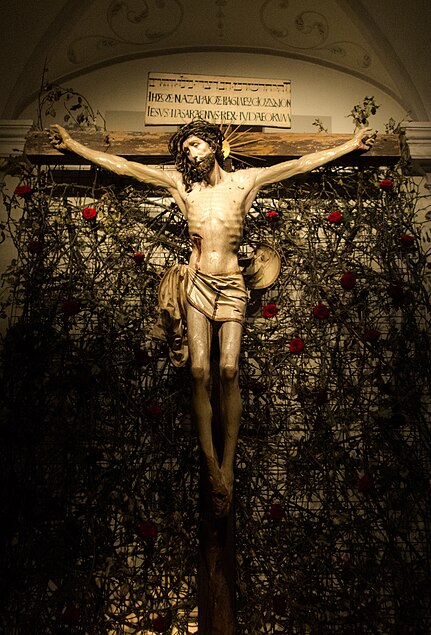
But I was also deeply saddened as I pondered the Jesus portrayed by this art, and imagined how different my life would be if this were the only Jesus I knew. Everywhere we went, the representations of Christ we saw were effeminate and dead. He was typically either nailed to a cross, or being tended by his mother or saints after his death. While it’s essential to spend time remembering how much Jesus suffered for our sins, our hope of eternal life comes from the truth that he is a risen, powerful Savior who conquered death and is alive and working today (1 Cor. 15:12-28).
This focus on death wasn’t just limited to Jesus. At each cathedral, we were greeted by a list of saints’ relics that were either available for regular viewing or on “special occasions.” These ranged from finger bones and scraps of clothing, to a martyr’s tooth and jawbone that had been encased in jewels. When I asked our guides what they thought about the churches and relics they were representing, their answers were insightful. Some responded, “This is the church I was baptized and married in!” although whether they still attended was less forthcoming. Others highlighted that relics do not fare well when subjected to DNA testing.
But one theme was universal: whatever the guides’ personal feelings about their churches, everyone agreed that the Protestant reformation was an inconvenient blip that had been decisively addressed by the Counter-Reformation hundreds of years ago.
I’ve had several months to reflect on this emphasis on death and the impact it seems to have had on the countries we visited, as well as do more research to compare data with the spiritual climate we sensed. For example, the Austrian embassy reports 3.8% of the population to be Protestant/evangelical, but most missions agencies believe this number is closer to 0.5%. Few Austrians actually attend the Catholic churches into which they were baptized. In recent years, New Age practices have begun gaining popularity with those searching for some form of spirituality.
I think there are many factors at work here, but one of them could be that we are highly influenced by the images we absorb as children. If we only see Jesus portrayed as dead and powerless, and are taught instead to seek the intercession of dead saints and professional clergy, to whom we also have limited access, what immediate or eternal hope does this offer? Deep down all of us know we will never be good enough to earn God’s favor, and how much confidence can we really put in humans who left this earth centuries before us?
As protestants in the United States, it’s easy to dismiss Reformation Sunday as the anniversary of a German monk nailing a theological treatise to the door of a church on the other side of the world. But visiting these cathedrals in Central Europe and witnessing the functional outworking of the Counter-Reformation has reminded me that Reformation Sunday represents so much more than just that. It represents returning to an understanding that we come to God through faith alone in a living, powerful, resurrected Savior, who made a way for us to speak directly with God in prayer without human intermediaries. It represents the freedom – indeed the responsibility – to read God’s Word for ourselves instead of relying on “professional Christians” like priests to tell us what God says about himself. And through these reformations of speaking to and hearing from God ourselves, Reformation Sunday represents a renewed understanding that God is not only immediately accessible, but he wants to hear from us and speak to us, each and every day.
I hope these reflections will remind you of privileges that, if you’re like me and grew up in a protestant church, we can often take for granted. I also hope that if countries like Austria, Czechia, Slovakia, and Hungary haven’t been on your prayer radar until now, you will join me in praying that God will pave the way for his gospel to gain more and more traction in these countries. He may even have a role for you or me to play!
It’s also crazy that Ivan and I are approaching 10 years of marriage this December. A decade seems like a long time, but given my accident and years of battling seizures, we both commented that we feel more like newlyweds! Much of this year has been focused on slowing down, taking stock of where we’re at in our relationship with the Lord and each other, how much we’ve learned, and more importantly how far we have yet to go.
That’s why I’ve been meditating on this verse from Psalm 51:
“Create in me a clean heart, O God, and renew a right spirit within me.”
Psalm 51:10
I think it’s an interesting contrast, especially for those of us who’ve been believers for a long time. Whether or not we’re repenting of grievous sin like David was, it’s interesting to consider why he pairs these requests.
He could have simply asked God to cleanse his heart, but asking God to “create” a clean heart sounds more like starting from scratch. However, in the next line, the word “renew” highlights that he’s not coming to God for the first time, or in our modern language “becoming a Christian.”
Perhaps this paradox can be explained by the parallelisms that occur in Hebrew poetry, but I think it also captures the experience that many of us encounter when we run into a problem or sin that seems so overwhelming it can only be solved by God giving us a heart transplant. Yet that verse’s second half, “renew a steadfast spirit” acknowledges the reality that sometimes this happens even when we’ve been walking with him for a long time.
Ultimately, our hope for continued transformation does not lie in our own willpower. Although David was writing in the Old Testament, he pleads “take not your Holy Spirit from me” in verse 11. His experience of the Holy Spirit was different from ours. However, he knew that his ability to overcome sin was not due to his own strength, but God‘s enabling presence and power. This is even more true for us today after Jesus’ resurrection (John 14:16-24).
While I hope few of us hit lows as deep as David’s, I think the desire for a “new heart” is relatively common, and I love that God in his wisdom prompted David to pair the request to create a clean heart and renew a steadfast spirit – two actions we might consider mutually exclusive – in the same verse.
For Ivan and me, we’re extremely grateful for all God has done in our lives, but we can also be tempted to feel like we should be further along relationally or spiritually. Meditating on David’s life and how he was called “the man after God’s own heart” although his trajectory was far from linear, and pondering how this single verse brings so much insight to the complexities of sanctification has been greatly encouraging. I hope it will encourage you as well!