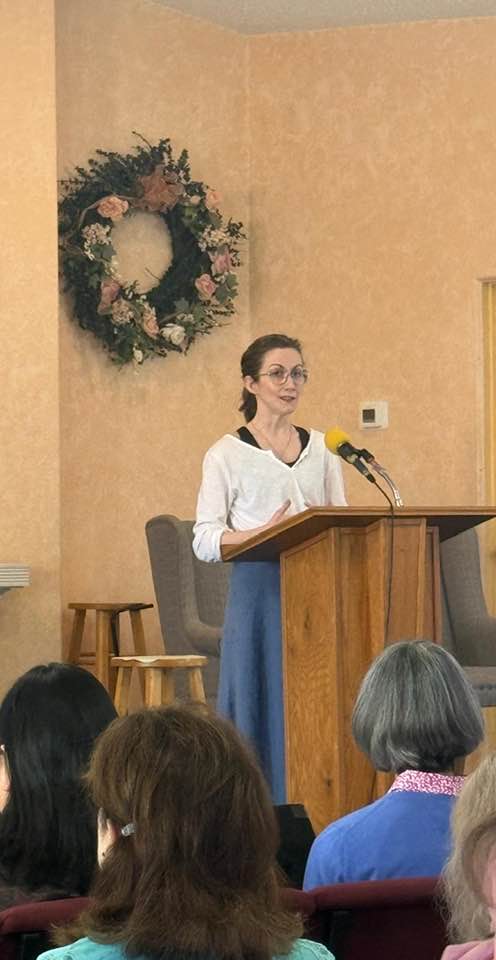
Good afternoon, Blogging Family! Last weekend, I was grateful to be one of the guest speakers at a women’s conference in Pacheco, CA, co-hosted by Foothill Baptist Church and Christ Church of All Nations (Ivan’s parents’ church). It was such a privilege to collaborate with the other speakers and meet women from other churches and backgrounds. It was also a growing experience for me, since the two areas that I am most comfortable with are counseling and prayer ministry (both one-on-one settings). Although I do love to teach music and writing and we have been blessed to share our accident story quite a bit in larger contexts, this was the first time that I prepared a message and spoke on a topic that was not related to our accident.
God was very faithful, and throughout the process I discovered that a lot of the skills I’ve developed in both teaching writing and preparing for counseling sessions were similar to what I needed to prepare a conference session. The similarities were studying what the biblical text said, consulting other passages from Scripture that shed more light on it, looking for relevant commentaries, and prayerfully discerning my own thoughts about the passage. Perhaps most important was praying that the Lord would use the passage to minister to (and convict!) my own heart during the preparation process, and also praying for the hearts of everyone who would attend. My conclusion after going through this process (although I admit that I am still very new to it), is that there is not a huge difference between preparing for a conference talk and counseling, except that I would say delivering a conference talk currently feels more disorienting to me.
In counseling, I can dialogue with the other person and try my best to sense by their tone of voice, facial expressions and verbal responses how they might be processing what I am sharing, or if they would benefit from a different approach. While this does not necessarily guarantee that every session goes well, and it is only God who does the transformation in a person’s heart, it does frequently provide a real time gauge to help me discern if the direction I am going is actually beneficial or if I need to change courses.
In contrast, delivering a conference talk does not allow this kind of real-time feedback and requires much more faith that God is the One who will work through (and in spite of) me, and that ultimately He has promised His Word never returns void, no matter how little I may know about each person in the room or how imperfectly I may communicate.
This past Saturday, I was grateful to speak on the life of Abigail. Meditating on how she wisely responded to a very complex situation (a foolish and ungodly husband and a future king who was sinfully angry) convicted me about 1) how much I take my own healthy marriage for granted and 2) how much I struggle to live out her example of honoring Nabal’s and David’s God-given positions. Far too often, I use other people’s sin as an excuse to justify my own. In Abigail’s case, God rewarded her willingness to submit to the position rather than fixating on the person who was not living up to his position. Her humility brought conviction to David’s heart, saved the lives of her male servants, and, after her husband’s death, gained her what we can guess was likely a better life as David’s wife.
Abigail could have sought to preserve her own life by running away when her servants brought her the news of David’s impending wrath, and perhaps she might have succeeded. However, by doing this she would have become implicit in the murder of Nabal’s servants, at least some of whom were not as wicked as Nabal himself (vv.14-17). By seeking to dissuade David from his murderous design, Abigail identified herself with Nabal’s guilt in order to intercede for him. This put her in danger since she did not know how David would respond. As Nabal’s wife, she was also aware that he did not deserve this intervention and she would not receive any personal benefit, except the benefit of honoring the Lord and the husband He had sovereignly allowed into her life, and potentially saving some innocent lives if she succeeded. It’s also worth noting that God’s justice in punishing Nabal was much more accurate than David’s sinful anger would have been. By eliminating Nabal through an adverse health event (perhaps a heart attack or stroke), God only punished the person who needed punishing. He also simultaneously freed Abigail and Nabal’s servants from their oppressive situation. David, however, was planning to wipe out “every male” belonging to Nabal, which would have included at least some innocent servants.
I’d like to close with this New Testament admonition and encouragement. It’s how I ended my conference talk Saturday I think it encapsulates the story of Abigail, Nabal, and David – and God’s intervention in all their lives so perfectly, I also hope it can encourage you all with whatever you may be facing this week!
Do not be deceived: God is not mocked, for whatever one sows, that will he also reap. For the one who sows to his own flesh will from the flesh reap corruption, but the one who sows to the Spirit will from the Spirit reap eternal life. And let us not grow weary of doing good, for in due season we will reap, if we do not give up. So then, as we have opportunity, let us do good to everyone, and especially to those who are of the household of faith.
Gal. 6:7-10

