The Battle to Believe

“For God gave us a spirit, not of fear, but of power and love and self-control.”

The verse’s assurance knocked the breath out of my shivering, twelve-year-old body that Sunday morning. Suddenly everything –  the chilly sanctuary with its stiff wooden pews and the filigreed pocket Bible that was the light of my preteen eyes – vanished in the blazing glory of the Apostle Paul’s declaration. 

Can this really be true? I faltered in the face of my hitherto unshakable fears: How would I score at my next violin competition? Would “normal” kids ever accept me since I was homeschooled and loved literature and classical music? What’s more, my fears were founded on reality. I could perform poorly, and I’d experienced my share of social rejection. But God, through the Apostle Paul, was promising me power, and love, and self-control in spite of my experiences. And God never lied. How would I respond? 

That morning was the first time I remember encountering 2 Timothy 1:7, but since then God has reminded me of that promise at crucial moments when I’ve felt like I was about to be overpowered by fear. Perhaps my preteen troubles seem trivial to us adults, but we can all remember how the hardships we experienced as young people seemed like the pinnacle of suffering. It’s only with additional life experience (and cognitive and emotional development), that we gain perspective to evaluate those circumstances in a more holistic light.  

The same is true of our suffering as adults. Perhaps an illness, or lay-off, or relational fracture that seemed almost beyond our capacity to endure five years ago looks different now that we have seen God sustain us over time and discerned what he was teaching. Each time he brings us through a trial, it should increase our confidence in his faithfulness for the next trial. 

I say “should” because in my own life, I’ve discovered this process is not always linear. Severe physical suffering has been a personal theme for many years, and I’ve been blessed that God had helped me to cling to what I know to be true of him and his Word during those times. But as God graciously removed the suffering I endured from uncontrolled seizures, I’ve been confronted with some relational disconnects that the seizures camouflaged. And I’ve discovered that, because of my brain injury, painful emotions can shake me much more deeply than physical suffering ever did. Although my verbal skills are high, my rational and emotional processing can become disconnected when I perceive something’s wrong or there’s actual conflict. The result is that even though I know certain things are true about God, his Word, or even a particular person, it can be extremely hard to overcome the hurt once it’s imprinted. 

I share this struggle because, while not everyone has a brain injury, I believe we all find ourselves in similar situations at some point. There will come a time for all of us when what we know about God and his Word – and possibly the person in front of us – doesn’t line up with how we’re feeling. And we’ll discover our feelings seem impossible to overcome. Like my twelve-year-old self on that Sunday morning, we’ll be confronted with the question, “Now what?” My preteen fears didn’t vanish overnight. I memorized 2 Timothy 1:7 and repeated it over and over again before I saw measurable change. I’m still in the trenches of a daily battle to believe that God’s Spirit of “power, love, and self-control” is fully available to me every moment of every day, no matter what the day may hold. The key is to keep asking God for his power, trusting that he never gets tired of my requests (James 1:5), and that he delights to give good things to all who ask him (Luke 11:13). That is who he always has been, and that is who he always will be. Will you join me? 

On the Road Again: Embracing Reality

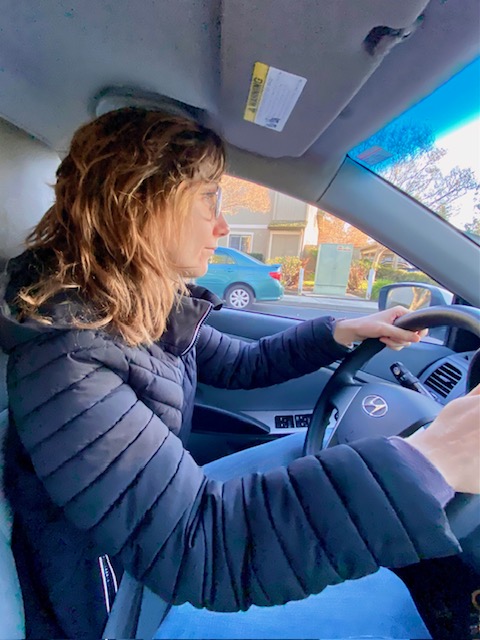
The first  few minutes are flawless. Traffic flows seamlessly on either side of our white Hyundai. The sun dances playfully off the windshield. Then, in a millisecond, everything changes. Maniacal drivers whip past me at the speed of light. My pulse charges and my breathing shallows.  Blood roars like an ocean in both ears. 

I can’t do thisI have to get out of here – right now!”

But there’s no exit from a vehicle hurtling down the highway at 65 mph. My life – our lives – are in my shaky, sweaty hands. One of which can’t feel the steering wheel. All I can do is force myself to keep breathing and pray that the panic passes quickly.  

When Ivan and I started my driving journey a few months ago, we decided to focus on the essentials and delay freeway driving until I got my license. Looking back, this was the most efficient strategy given Ivan’s busy work schedule and limited amount of time to help me practice. But now that I’m a licensed driver again, we find ourselves caught in an unusual tension between “already” and “not yet.” 

It’s amazing that I can drive at all. If you’d suggested my hopping in the driver’s seat this time last year, we would have written it off as inconceivable due to both my history of seizures and residual neurological deficits. Over the past year, God’s graciously removed the barriers that once made driving out of the question, but the skill remains more mentally and physically draining for me than the average person. 

Although it’s not readily apparent to observers, neurocognitive testing has shown that my brain works about 60% harder to process input and produce output than a healthy brain. We’d previously discovered that driving to and from an activity added another layer of fatigue for which I needed to account. And, as I’ve experienced since venturing onto the freeway with Ivan in recent weeks, driving at high speeds seems to exacerbate that deficit. The good news is that, with patience and practice, we believe I’ll be able to adjust to this, just like I learned to steer the car without feeling my left hand and also increased my mental stamina by driving in town whenever possible.

In the meantime, this unanticipated challenge is presenting an opportunity to be thankful for what the Lord has already given, and to continue waiting on his timing. I’d imagined a seamless transition from getting my license to zipping across the Bay Area at will. Awkward conversations that begin, “Well, I do drive now, but I’m still not comfortable on freeways …could we choose a different location?” never crossed my mind. This is challenging me to be honest about my weakness, and trust that God will use this inconvenience in both my life and the lives of those I’d like to meet with, although it’s humbling to keep asking for accommodations after I’d anticipated being completely independent. On the flip side, this discomfort is also good motivation for Ivan and me to keep practicing freeway driving, in the hopes that one day I will be able to navigate safely on my own.

Re-learning to drive on the freeway as an adult is unusual, but the fear of being honest, or falling short in some other way, are struggles we all face. So is discovering that a much-anticipated blessing also contains hidden snags. While it’s easy to focus our energy on engineering our ideal outcome, the truth is that God sovereignly orchestrates the exact circumstances that are best for our good and his glory. Perhaps we would not depend on God as much if life were more comfortable. Perhaps there’s sin in our hearts he’s using difficult circumstances to reveal. Or perhaps he’s simply employing a season of testing or waiting to reveal himself in ways we could not experience otherwise. 

For me, I’ve been convicted of my tendency to forget about past blessings (like being able to drive at all) and fixate on what I wish were different now. I’ve also noticed how often I worry what other people think of me and seek to justify myself. Finally, I see how much I need to grow in contentment and embrace the season God has me in currently. As much as God’s graciously given back over the past eighteen months, my body continues to function at a level that is different from most people’s. However, that shouldn’t be a reason for frustration. God can continue working in my life as he sees fit, but I want to trust that whatever he chooses to do will be the very best for my good and his glory.  

Where the Pressure Lies: Reflections on 8 Years

Today marks the eighth anniversary of my accident. Comparing December 3rd, 2024, with December 3rd, 2023, I can honestly say that God has radically transformed my life. Today, I no longer have seizures or experience severe spiritual warfare. I recently got my driver’s license. I continue re-learning to play violin. Although I still face severe migraines and other neurological deficits, my quality of life looks drastically different from what I could have imagined 365 days ago. But these divine interventions also beg the question, What about the suffering and uncertainty we endured during those first seven years?

From a human perspective, it would have seemed more humane for God to heal my seizures immediately, or at least shortly after they started, rather than allowing us to agonize over possible causes and cures for so long. Not to mention the social isolation we experienced due to my severe light sensitivity. Since I’m not God, I can’t say with certainty why he chose to act the way he did, but I have a few guesses: 

  1. Exhausting our human medical options forced us to look to God alone for our “daily bread,” whether that took the form of healing, partial improvement, or just the grace to endure joyfully no matter our outward circumstances. 
  2. Our intense suffering increased our empathy for others’ hidden hurts. Seizures are invisible unless they’re happening, and brain injury deficits and stroke fatigue are even more subtle. They may not manifest until hours after I’ve been pushed past my limits. Depending on how far I’ve been stretched, I may have to spend a day or two recovering. These “invisible” challenges increased my awareness that others might also be experiencing secret pain, whether physical or emotional.
  3. Those years of suffering drove home that God is both sovereign and kind, no matter how he chose to work in our lives. While we knew he could end our suffering at any time, the most straightforward path seemed like a medical intervention. However, we also knew a couple of people with seizures who were unable to find a medical solution, and eventually decided this must be God’s plan for us as well. But no matter how our earthly lives unfolded, we were still certain that God was good, kind, and for us because he’d already provided eternal salvation through Jesus’ death on the cross. The Apostle Paul writes:  

“What shall we say about such wonderful things as these? If God is for us, who can ever be against us? Since he did not spare even his own Son but gave him up for us all, won’t he also give us everything else?  Who dares accuse us whom God has chosen for his own? No one—for God himself has given us right standing with himself.” ~ Romans 8:31-33

The promise that God will give us “everything else” means something unique for every person’s story.  In our case, we assumed “everything else” meant spiritual blessings because we’d exhausted all our medical resources. But God was only asking us to wait. It was essential for us to run out of human options so there would be no shadow of a doubt about Who accomplished my healings.

So what does the promise God will give us “everything else” mean for those who’ve lost a loved one, or are facing unemployment, or have endured severe disabilities for decades? God’s thoughts and ways are infinitely higher than ours, and if he is allowing pain in our lives, it is because there is a loving purpose that our pain is somehow his perfect tool to accomplish. If God didn’t hesitate to crush his precious Son on our behalf, then there is no good thing he would withhold from us – if that thing is what we truly need. And if he does withhold it, then there is something about our desire that he sees but we cannot.

This is the hardest lesson that Ivan and I have had to learn over the years. If I’m being honest, I haven’t learned it yet. But I hope I learn it a little bit more with each trial God allows. This quote from Hudson Taylor, a 19th century missionary to China, continues to encourage me in moments of pain and weakness:

“It does not matter how great the pressure is. What really matters is where the pressure lies – whether it comes between you and God, or whether it presses it you nearer His heart.”

Thank you all so much for praying for us and walking with us for the past eight years! We’re so grateful for your love and support, and can’t wait to see what the next year will bring!

A Licensed Driver!

“Please – I just got my picture taken three minutes ago. Does that mean we can leave and my driver’s license will come in the mail?”

The DMV manager – no doubt frazzled by an onslaught of similar questions – shrugged.

“I don’t know what to tell you. Computers are down statewide. You could hang around to see if the system comes back up, or you could come back tomorrow and restart your application.” She spun on her heel abruptly to signal our conversation was over. 

Her words threatened to extinguish my sputtering hopes like a bucket of ice water. My original road test – scheduled for October 14th – had been canceled after I arrived due to an administrative mix up. At the time, we’d been told it would be several weeks before we could expect my case to be reviewed, or the test rescheduled. 

But God intervened, and last Monday we received a nondescript envelope in the mail  from the DMV. This puzzled me since we’d been told to expect a phone call to discuss my current medical status in greater detail. The envelope’s contents were even more puzzling: All it contained was a form letter stating I could renew my driver’s license at any DMV field office. This seemed like another administrative error since there was no mention of a road test; however, when I called the next morning to verify, the voice on the phone assured me that the letter was correct. My medical case had been been closed. We’ll never know what changed between the test being canceled on October 14th and then waived last week, other than God wanted to teach us extra patience – and give me extra time practicing my driving skills. And I practice for tests very seriously! 

In God’s good timing, Ivan was available to take me to the DMV last Wednesday afternoon. This is significant because Ivan’s work schedule has evolved a lot this semester. School technically ends at 3 pm, but between private piano students and administrative duties, he often works late or returns to school at night. Hence my dismay at the DMV manager’s suggestion that we restart my license application on a different day. It could be weeks before we had another open afternoon.

Oh Lord, I prayed. We’ve waited so long. First there was the road test cancellation, and then you intervened to take that off the table. A statewide system shut-down is nothing to you, Lord. Please, if there is some way, any way, please let us leave with my license today. 

The manager told the disgruntled crowd that everyone waiting for driver’s licenses should go home and come back a different day. They’d keep processing car registrations, but licenses were over. I kept praying. The clerk who had been processing our application when the system crashed quietly told us not to leave. Ivan and I ambled back to the rows of blue plastic chairs and sat down dejectedly as half the crowd left and the other half selected fresh numbers and reformed a line. 

“What do you think we’re waiting on?” I asked. 

Ivan shrugged.

“She didn’t give us a number.”

“Maybe she’ll call us if the system comes back,” he replied. 

We sat in silence as the clock ticked inexorably toward 5 pm. The car registration line moved quickly, but new driver’s-license walk-ins continued to be turned away. 

Please, Lord, I prayed. All we need is one computer to come back. I realized God could have allowed this bizarre turn of events to teach Ivan and me even more patience, but it all seemed so strange. We hadn’t anticipated getting my license for several more weeks: why would the Lord surprise us with hope so unexpectedly, only to have things not work out at the last moment?

“Okay, let’s go check again.” Ivan’s voice interrupted my musings. I looked up at the clock. The office would close in a few minutes. We shuffled back to the station that had been processing our application.

“Still down,” the clerk shook her head and sighed. My heart plummeted. Then – “Hold on a sec.” She gestured for my paperwork and disappeared. Ivan and I exchanged confused glances. I no longer knew what I was praying for if the system was still down, but I kept praying. The woman’s absence felt even longer than the time we’d languished in the waiting area. 

When she reappeared, she was holding a thin slip of paper. 

“There was one computer still running in the back.” The clerk smiled faintly. “Here’s your license.” She passed the slip under the glass partition. 

“Oh! Thank you! Thank you so much!” I beamed as I snatched my prize.

The lady couldn’t have imagined the all the feelings she triggered by double-checking: Seven years of relying on others anytime I needed to go anywhere, followed by the nerve-wracking process of reacclimating to the road, followed by a canceled road test and the uncertainty of when I could actually get my license. Perhaps, for her, checking was simply the “nice” thing to do. For me, it was the beginning of a whole new world. 

Both Ivan and I are overwhelmed with gratitude to God for this new chapter in our journey. Our suspenseful DMV visit reminded us that my driving again has never been guaranteed, or even expected. It’s a gift, and one that God can give and take back at any time, whether or not it makes sense to us in the moment. We’re very grateful that in God’s love and mercy, he’s decided that my driving again will bring him glory. But that, like all the healing he’s done in my life, is an undeserved blessing. We pray he will help me to be a good steward of it for as long as he allows me to be on the road. 

***

P.S. Here’s an in-depth post about some of the stroke and TBI deficits I still have to manage while driving, and here’s a more light-hearted post about what it was like to actually get reacclimatized to the road. Thanks so much for walking with us!

Worshiping While Waiting

I avoid hikes due to the hardware in my legs, but this is a throwback from a rare visit to the Redwoods – itself an answer to many prayers!

Happy November 1st, Blogging Family! Many of us are anticipating (and hopefully praying about) Election Day. The course our country charts this Tuesday will influence not just daily life, but also global events for at least the next four years.

But whether or not you consider yourself political, I’m confident we all have cherished personal prayer requests we carry to the Lord regularly. That was one of the main reasons we started this blog in 2017 – to ask for prayer during my initial recovery. 

My gratitude for your faithful prayers, as well as a question I received after my recent testimony video, is why I’d like to share a brief devotional on Matthew 15:21-28. The question was, “What if God hadn’t granted that prayer for deliverance? Would that have changed your outlook on what you were experiencing or how you addressed it?” 

The short answer is, “No.” We are commanded to keep praying and trusting what God has said about our trials and how to respond to them, whether or not he chooses to take visible action on a given day. But better than my short answer is this historical account from Matthew, which has encouraged me throughout years of waiting on the Lord, both for physical healing and spiritual growth. It continues to refresh me as I come into his presence each day, and I pray it will encourage you as well.

Then Jesus left Galilee and went north to the region of Tyre and Sidon.  A Gentile woman who lived there came to him, pleading, ‘Have mercy on me, O Lord, Son of David! For my daughter is possessed by a demon that torments her severely.’

But Jesus gave her no reply, not even a word. Then his disciples urged him to send her away. ‘Tell her to go away,’ they said. ‘She is bothering us with all her begging.’

Then Jesus said to the woman, ‘I was sent only to help God’s lost sheep—the people of Israel.’

 But she came and worshiped him, pleading again, ‘Lord, help me!’

Jesus responded, ‘It isn’t right to take food from the children and throw it to the dogs.’

She replied, ‘That’s true, Lord, but even dogs are allowed to eat the scraps that fall beneath their masters’ table.’

‘Dear woman,’ Jesus said to her, ‘your faith is great. Your request is granted.’ And her daughter was instantly healed.

I could write extensively about this passage, but for today there are three points I’d like to highlight. 

  1. We discover what likely drew the Gentile woman to Jesus in Matt. 14:35-36. These verses tell us that Jesus was healing all the sick who were brought to him. Even those who merely touched the hem of his robe were healed! No rejections. No “too busy’s,” “too tired’s,”  or “come back later’s.” And these healings didn’t even require a direct touch, or Jesus’ full attention. Then, Jesus heads to Gentile country. Why would he go there if he weren’t planning to do something similar for the Gentiles? But when this lady shows up, she finds something totally different from everything she’s heard. Jesus not only won’t help her. He won’t even answer her. 
  2. We often get frustrated when we pray and God doesn’t respond immediately. But how would we react if Jesus were standing a few feet away from us and unmistakably ignoring us? Especially when we had proof he’d healed hundreds – if not thousands – of others in similar predicaments? Talk about reasons for a “faith crisis.” But the Gentile woman doesn’t get angry, or even impatient. She also doesn’t stop asking. Instead, she pauses to worship.
  3. There was nothing praiseworthy about what this lady was experiencing. Jesus’ behavior must have seemed like it contradicted everything she’d heard about him. And the disciples weren’t being very helpful either. So why was she worshiping? By the title she uses to address Jesus, it seems that she’d already believed he was the Messiah before asking for healing. Her decision to stop and praise expresses trust in what she knows is true about him, regardless of how he responds.

When we think carefully about Jesus’ final response, we realize that he wasn’t being callous or capricious. His apparent indifference actually served two good purposes. Not only did it briefly test the Gentile woman, but it also elicited a faith-filled response that stood in sharp contrast to the skeptical Jews who were constantly demanding more miracles as proof of his Messiah-ship.

For those of us who are waiting on the Lord to answer our own cherished requests, the lady’s courageous petition-worship-petition example also functions as both challenge and encouragement: Is our faith contingent on our circumstances? Can we worship while we wait?