Hello Blogging Family, thank you for your prayers and encouragement in response to our recent news! Between our upcoming move to Indianapolis, and Grace’s unexpectedly clear MRI, God has really been teaching us to trust in Him in recent weeks.
Have you ever felt like only about 17% of your plans come to fruition the way you anticipated? Maybe some of us can boast of a >50% success rate. But even the best planners among us can’t guarantee a 100% success rate, because, well, we aren’t God.
Isn’t it interesting how, despite knowing this in our heads, we often still get surprised or frustrated when our powers of prediction fail us? When, inevitably, an unlooked for circumstantial factor enters the equation, or people somehow don’t react the way we thought they would, or should?
Reflecting on my own life, I can name many examples of how God “redirected” my plans: when I was in college, I wanted to teach at a college/university. God has placed me in K-12 environments, in which I’ve grown so much as an educator, and for which I am very grateful. I had also anticipated staying in San Jose for the bulk of my teaching and administrative career, but God has opened the door for a new chapter in Indiana.
Even before I’d met Grace, I had wanted to one day get married and have a family; eleven months into our first year of marriage, Grace experienced her accident. This eventually led to us being told by medical professionals that the biological route to parenthood would be closed to us permanently, due to Grace’s seizures, and still partially-dissected carotid artery. In God’s wonderful sovereignty, at this point, He has removed both of those medical barriers.
Wow. Thank you Lord!
God gives, and God takes away. All things are from Him, through Him, and to Him. The apostle James gently but firmly reminds us:
Come now, you who say, “Today or tomorrow we will go into such and such a town and spend a year there and trade and make a profit”— yet you do not know what tomorrow will bring. What is your life? For you are a mist that appears for a little time and then vanishes. Instead you ought to say, “If the Lord wills, we will live and do this or that.”
James 4:13-15
As we walk with the Lord each day, may we more and more learn to surrender all aspects of our lives to Him, trusting that He knows infinitely more than we do, and He cares for us more than we can comprehend. When He “redirects” us, it will always be for His glory and our good.
Whatever you are facing today, whatever decisions need to be made, whatever unexpected news reaches you–know that the God of the universe is with you, and He will shepherd you with goodness and mercy. May we be encouraged by the lyrics to this song:
“Many things about tomorrow, I don’t seem to understand; But I know who holds tomorrow, And I know who holds my hand.”
Hello Blogging Family, Grace and I have some bittersweet news to share…after nine and a half years in San Jose, Lord-willing we will be relocating to Indianapolis next month! I’m excited to share that I’ve accepted the position of Fine Arts Director at Heritage Christian School. The Lord has been so gracious to open this door of opportunity, and we are trusting Him to continue guiding us in this next chapter.
As the prophet Jeremiah said:
“The steadfast love of the Lord never ceases; His mercies never come to an end; they are new every morning; great is Your faithfulness.”
lamentations 3:22-23
Truly, great is God’s faithfulness. It’s often easier to see this in hindsight, but it is nevertheless true at all times. When Grace and I moved from Riverside to San Jose in June 2017, we could never have imagined all that lay ahead for us here. We moved with the mindset of, “God will provide” — and He did, in a way only He could have.
As many of you know, my training is as a musician; my undergraduate and Master’s degrees are in Piano Performance. In tech-saturated Silicon Valley, this is a bit of a niche skill set. Many professional musicians make a living by combining incomes from performing, teaching, and maybe composing or arranging. However, given Grace’s acute medical needs at that time, I knew we needed more financial stability than a gigging lifestyle could provide. Teaching music at a school would allow me to use my music training while providing a stable income.
In God’s great mercy, He opened the door for me to work at Valley Christian Schools (VCS) immediately after we moved to San Jose. I initially applied to teach Junior High science (not having a professional background in science, but knocking on every door I could find). In God’s providence, very kind and helpful people helped me connect with the Director of the Conservatory of the Arts at VCS. I spoke with him and he graciously invited me to join the Conservatory team as a Junior High and High School teacher.
Over time, I shifted my emphasis from teaching to school administration. Four years ago I took on the role of Associate Director for the Conservatory; and last summer by God’s grace I completed my EdD in Organizational Leadership. I’ve really enjoyed working in school administration, as it’s given me the opportunity to think strategically while at the same time continue to work with teachers, students, and families.
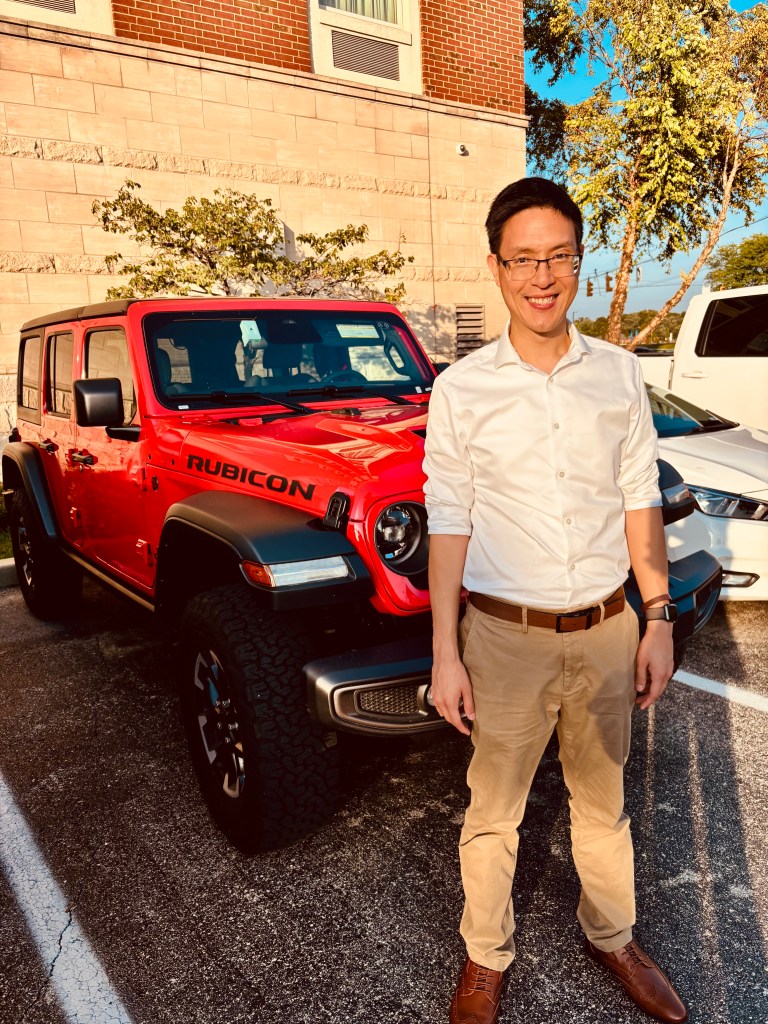
This past summer, I became aware of Heritage’s search for someone to lead their arts department; we connected, and on August 31st, Grace and I flew out to Indianapolis so that the following day I could visit Heritage in person. In God’s timing, the Fine Arts Director position was offered, and I accepted. (Incidentally, this is also where the picture above comes in; we had reserved a “compact” rental car online, but received the pictured Jeep Wrangler instead! Neither Grace nor I had driven a Jeep before, so this was also a new adventure. 😉)
I used the word “bittersweet” at the beginning of this post because, while Grace and I are excited for this next stage in my career, we are at the same time very much not looking forward to saying goodbye to the many wonderful people we’ve met and formed relationships with here in the Bay Area. To our San Jose community: thank you for being channels of God’s blessing in our lives over these past nine years. May you seek the Lord more and more each day, and may He lead and bless you.
To our future friends and community in Indianapolis: We look forward to walking alongside you, and pray that God would use us to bless and encourage one another as we seek to honor Him in all we do. To all our blog family, thank you for faithfully walking with us over the past (almost) ten years! Here’s to new horizons.
As a TBI survivor, I am deeply aware of what it means to live with an invisible, life-altering, injury. Depending your own life history, you may possess scars that are apparent to the naked eye. Or perhaps you’ve experienced trials that don’t manifest physically but still have wide-reaching emotional and spiritual effects. 2 Cor. 3:17-19 is a passage that God consistently uses to encourage me, and I pray it will be encouraging to you all as well!
“Now the Lord is the Spirit, and where the Spirit of the Lord is, there is freedom. And we all, with unveiled face, beholding the glory of the Lord, are being transformed into the same image from one degree of glory to another. For this comes from the Lord who is the Spirit.”
One result of my injury brain injury is that I struggle with hypothetical thinking. Whether or not you share a similar physical challenge, finding hope for today in the amazing future promises that the Apostle Paul lays out may feel difficult. How does the promise of future glory transform our daily experience in concrete ways?
We begin by remembering God’s character never changes. (Malachi 3:6). Therefore, we can trust that His Word – and the promises it contains – are completely trustworthy and not subject to alteration. We also see God explicitly declaring that His Word expresses both His sovereignty and His foreknowledge in Isaiah 46:9-10: “I am God, and there is no other… declaring the end from the beginning and from ancient times things not yet done, saying, ‘My counsel shall stand, and I will accomplish all my purpose.'” Putting all these concepts together, we can trust that when God supernaturally inspired men to author Scripture, there were not any human conditions or events at any point in history that would occur outside of His sovereign plan or that His Word would not be sufficient for.
From this foundation, we can move into the basic promise of 2 Cor. 3:17, which although a bit more abstract, is still relatively accessible. If we are believers, Paul is saying that we have all already received the Holy Spirit. If you notice what I am doing here, I am still dealing with facts that are either eternal (can be thought of as present tense) or took place in the past (usually easier to conceptualize).
Next, we see that Paul says the Holy Spirit produces freedom in our lives. This is moving toward the conceptual, but is still relatively recognizable. That being said, we can make it more concrete by asking: What would I like to be rid of? Or, What would I like to be able to do? While we don’t know God’s plan for physical healing in everyone’s life, we do know that the Holy Spirit always gives believers the power to grow in knowing and loving Him and loving others (Matt. 22:37-39; 2 Peter 1:3-9). He wants us to get rid – be free – of attitudes, actions, and circumstances that hinder these goals. We should also seek out attitudes, actions, and circumstances that help us foster these goals. Freedom comes from being more aligned with God’s goals, which are always more concerned with our heart than our physical abilities – or deficits.
While TBI often impacts emotional regulation, thus making certain aspects of loving God and others more difficult for me, Scripture tells us that no physiological calamity can touch our souls, and that God is in the process of renewing all of us. (Matt. 10:28; 2 Cor. 4:16). Although certain aspects of our sanctification may be more challenging depending on when we came to Christ, our cultural background, or even something like a physical limitation, we can be confident that it is still possible to grow in loving God and loving others. The more we submit to the work God wants to do in us through the power of His Word and His Holy Spirit, the more we will experience the “freedom” God promises us in 2 Cor. 3:17-19, whether or not we are able to imagine freedom as an abstract concept.
The same is true for the next promise – that we will be transformed “from one degree of glory to another.” This is the portion that has been the most challenging for me to conceptualize. Most of us can probably imagine concrete examples of beauty or pleasure, such as a kaleidoscopic sunset, or chocolate chip cookies baking, or the downy fur of your favorite puppy. “Glory” in a spiritual sense might be harder to call to mind in the same concrete way we do for beautiful or pleasurable earthly experiences. The good news is that no one knows for sure what heaven will be like, so those of us who have trouble visualizing what Paul is describing in 2 Corinthians 3 are in good company. What we do know for sure is that even now, everything God allows into our lives is conforming us “to the image of His Son” (Romans 8:29). When we get to Heaven, this transformation process will be completed. The Apostle John writes that “we shall be like Him, because we shall see Him as He is” (1 John 3:2).
For me, putting this verse into practice has meant looking forward to seeing my Savior face-to-face and enjoying His presence completely free from the lingering remnants of sin. I can’t wait to possess a mind and body that are perfectly suited to both glorifying God and enjoying Him forever. It also means looking forward to sharing this experience with fellow believers in our perfected state, free from the limitations and sin that can make even the best relationships challenging.
In the present, I think this also means looking for ways to praise God for how we see Him increasing not just our ability to love Him and love others, but also how we see Him increasing these abilities in the lives of those around us. This daily sanctification is the downpayment of the glory we’ve been promised, and the more we grow in identifying and expressing gratitude for His Spirit’s work in our lives, the more we will grow in our ability to anticipate and hope in future glory. This daily gratitude also reminds us that God is keeping His promise to complete His good work in all of us, even we are going through a trial or His work seems more apparent at certain times than others.
I am far from doing any of these things well or consistently, but I am grateful for how God continues to use this passage to renew both my mind and heart. I pray that sharing a little bit if my journey with this 2 Cor. 3 has been encouraging for you, and that God will use these verses to bring vivid hope for whatever you may be going through. We can trust that His promises never fail!
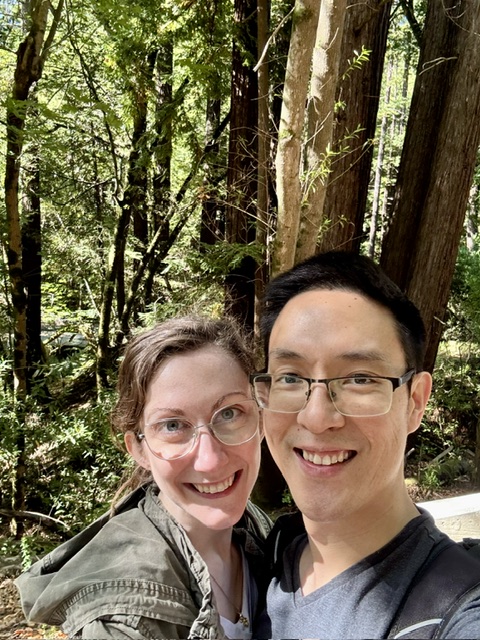
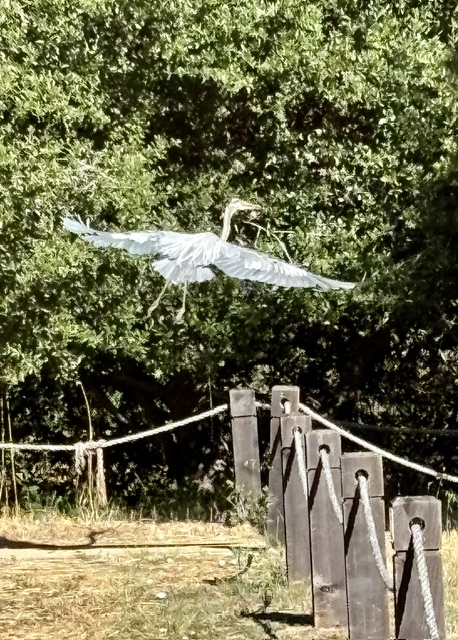
Good morning, Blogging Family! Two weeks ago Grace and I were looking for a new redwoods park to explore, and we found Bear Creek Redwoods Open Preserve, which was only 30 minutes away. Most other forests are over an hour away, either by Oakland or across the Golden Gate Bridge in Marin County. As you can see in Grace’s photo at the end of this post, we even spotted a heron successfully hunting a mouse!
While we were exploring, it was amazing to consider that the redwoods around us could live for hundreds of years, far longer than any human. It’s even more amazing to think about how “old” God is–that He is, in fact, older than time itself! He is beyond time; He transcends it. He is eternal.
This August also marks the beginning of my 10th year at VCS. I’m grateful for God’s grace and mercy in bringing me to this milestone! Yet ten years are like the blink of an eye, from an eternal perspective. As Moses said in Psalm 90:
“Lord, you have been our dwelling place in all generations. Before the mountains were brought forth, or ever you had formed the earth and the world, from everlasting to everlasting you are God.
You return man to dust and say, ‘Return, O children of man!’ For a thousand years in your sight are but as yesterday when it is past, or as a watch in the night.” (Ps 90:1-4)
I don’t know what this year will hold, but I know that God is still God. He has been my dwelling place, and will continue to be. Whatever you may be facing in this season, I pray that God’s eternal nature will comfort you too as you depend on His sovereign care for you. As Moses prayed, may we also pray:
“So teach us to number our days that we may get a heart of wisdom.”
Psalm 90:12
May God “establish the work of our hands” (Ps 90:17) as we humbly walk with Him each day, doing our best to steward what He has entrusted to us. One day soon, by the grace of Christ, we will see the Eternal One face to face and enjoy being with Him forever. Blessings to you!
Hello Blogging Family! It’s now been just about a month since Grace and I returned from our trip to Australia and Indonesia. I’m still so thankful that God allowed us to travel together, since in the early days of Grace’s accident I would’ve absolutely ruled out international travel. It’s good to be proven wrong by God.
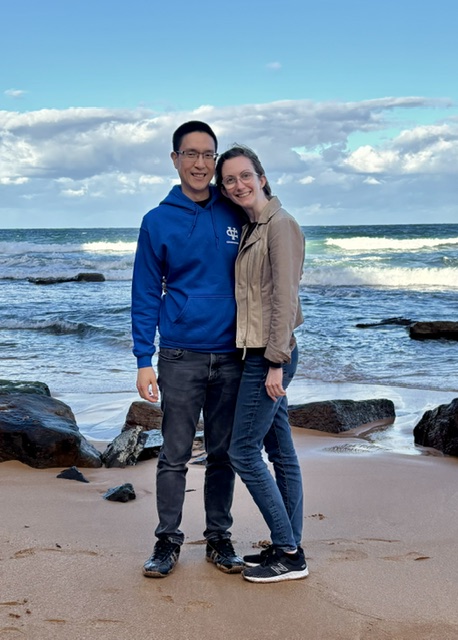
The picture above is from Newport Beach in Sydney. June is winter in Australia, so the temperature was in the 60’s when we visited this beach, pleasantly cool and not too hot at all! We were among the only people there that afternoon. I was struck by the wide expanse of the sky meeting the curving horizon in the distance. The view was bounded by towering rock cliffs on either side of the beach, creating a picturesque cove.
Living in the middle of a busy, tech-saturated city, it’s easy for me to forget the grandeur of the natural world God created. As impressive as man’s creations have been, they pale in comparison to the works of the Creator Himself–including ourselves.
Psalm 100:2 reminds us: “Know that the Lord, he is God! It is he who made us, and we are his; we are his people, and the sheep of his pasture.”
And David, in Psalm 8, famously said:
When I look at your heavens, the work of your fingers, the moon and the stars, which you have set in place, what is man that you are mindful of him, and the son of man that you care for him? O Lord, our Lord, how majestic is your name in all the earth!
Psalm 8:3-4, 9
How majestic is the name of the Lord, in Australia, Indonesia, California, and across the whole world! God, in His wisdom and grace, has made you and me “a little lower than the heavenly beings” (Ps 8:5). As human beings we bear the image of God Himself. What an incredible privilege!
Yet may we also never forget that we were never meant to be the center of the universe–either the actual physical universe, or the private ones each of us inhabit in our hearts and minds. Yesterday, our pastor was preaching on the topic of missions, and he pointed out that perhaps many of us have yet to experience the “Copernican revolution” of replacing a man-centered view of the reality with a God-centered view.
A God-centered view of reality was what prompted David to cry out, “What is man that you are mindful of him?” Is that how we view ourselves today?
Sometimes, even when I’m not fully aware of it, I act as if God owes me something. When I don’t get what I want, or get what I don’t want, the frustration or bitterness that ensues proves that, in that moment, I’m not viewing Him as my Lord but rather as my benefactor.
But Jesus’ rightful title has always been and will always be, “King of Kings and Lord of Lords” (Rev 19:16). The ultimate joy and blessing of this life and the next is to personally know and be known by the God who created the world, and us–to worship and enjoy our Savior and King forever. Be encouraged today that, in His grace, He is mindful of us.
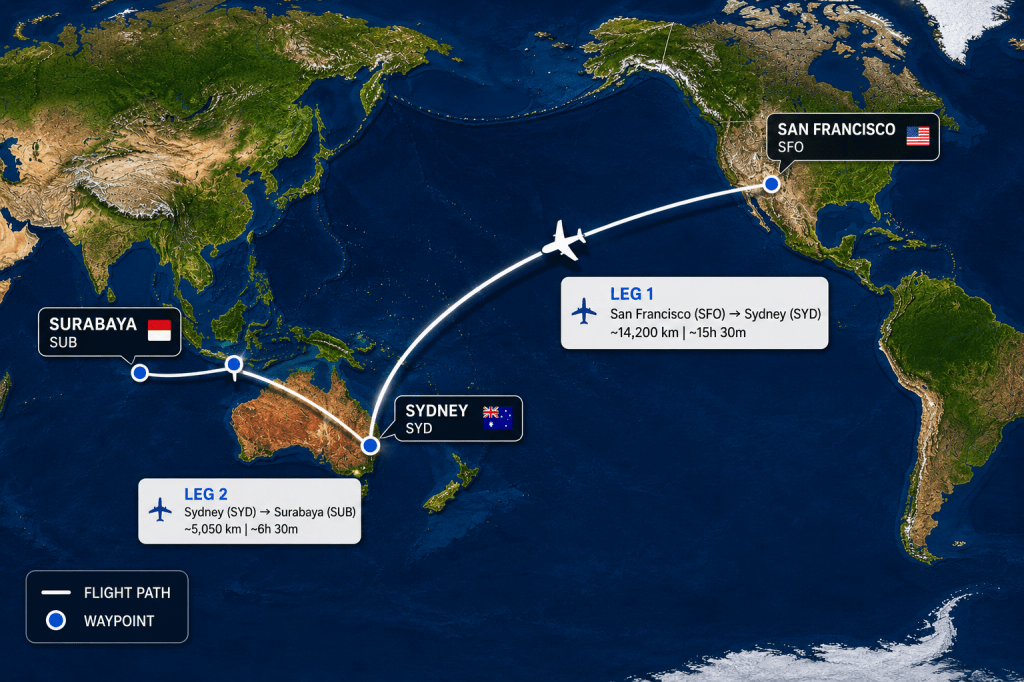
This is the best of several attempts to depict our flight path using ChatGPT. It has us taking off in Nevada and landing in the Indian Ocean 😉
Happy Wednesday, Blogging Family! We can’t believe that our long-awaited trip to Australia and Indonesia is just seven days away. As I shared in my first post in this series, although we’ve been blessed to travel internationally several times in recent years through VCS, our plan to visit Ivan’s family shortly after our wedding has been delayed almost a decade. This was originally due to my health and then subsequently to other factors like cost and Ivan’s travel schedule at work. We are so grateful to see God answering our prayers and opening doors to finally make our dream a reality after so much waiting!
One lesson we have learned – and I’m sure will continue learning – from our previous international trips is the importance of preparing our minds and hearts ahead of time. No matter how alluring the destination or exciting the itinerary, the truth is that jet lag, unexpected changes in plans, and (often) trying to navigate in a foreign language bring out our selfish tendencies and unreasonable expectations. Not to mention herding teenagers. We are blessed to be traveling without a group (for only the second time in a decade of marriage!), and at least one of us in a native speaker in both countries we’re visiting. What’s even more exciting is that this trip is purely relational, and has no work obligations.
Nevertheless, we’re both aware that although the circumstances surrounding our journey to Australia and Indo are different, the temptations we usually face will still be active. Since we bought our tickets a few months ago, we’ve been praying that God would help us to view this trip as an opportunity to seek to bless and encourage everyone we’re visiting. We’re praying that He would continue reminding us that this is an opportunity to serve His kingdom and is not a vacation meant to gratify our own desires, and guard us from disappointment if things don’t turn out exactly like we hope. One passage God has been bringing to mind recently is the opening to Colossians 3:
“If then you have been raised with Christ, seek the things that are above, where Christ is, seated at the right hand of God. Set your minds on things that are above, not on things that are on earth. For you have died, and your life is hidden with Christ in God. When Christ who is your life appears, then you also will appear with him in glory.”
Col. 3:1-4
Setting my mind on earthly hopes is a giant temptation for me with this trip, given that we’ve been praying for an opportunity to take it for many years and don’t know if or when we’ll be able to do it again. I’m also praying that, in addition to helping us focus on Kingdom priorities, God will help us to view each other with extra grace and compassion, and believe the best about each other in difficult situations (1 Cor. 13:7). When things don’t go as planned, it’s tempting to blame the person closest to you, whether or not that is the loving, biblical response.
Thank you so much for your prayers and walking with us, and I look forward to sharing more when we get back!
Happy Monday, Blogging Family! At this point, many of you know that my dad will be retiring from full-time ministry near the end of the year. Needless to say, this is a bittersweet transition for our family. It has already provided opportunities to reflect on how the Lord has provided for, sustained, and blessed my parents’ lives and ministry over the years. I’m sure we will continue grow in gratitude (and also sadness as their season of vocational ministry concludes) as Fall approaches.
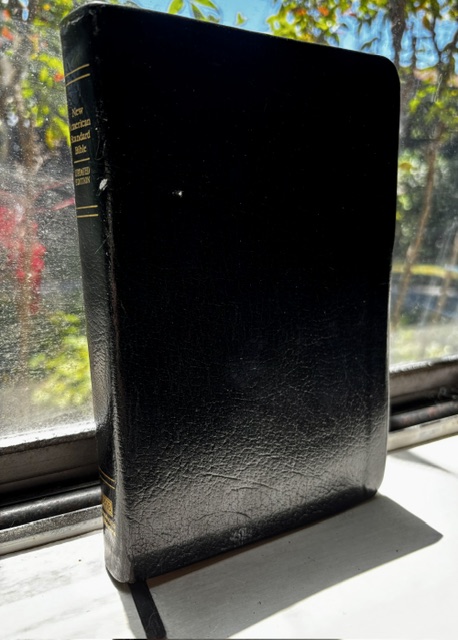
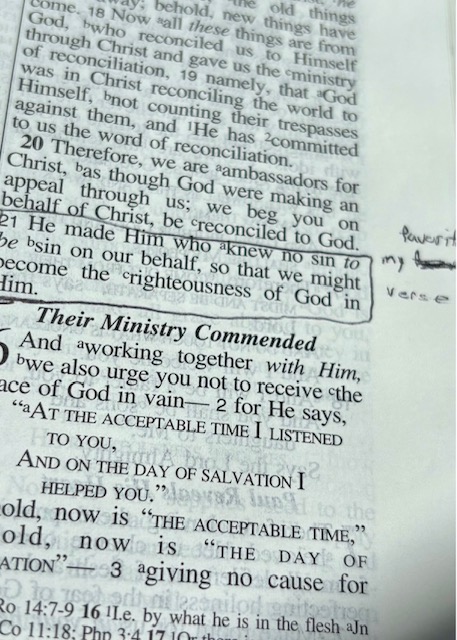
An unexpected blessing I’ve received during this time is rediscovering some “artifacts” my dad preserved in his office over the decades – and several cross- country moves. One of these was my first “grown up” Bible. Although I admit that I had forgotten about it in recent years, when Dad returned it to me last week, it brought back many childhood memories.
As you can see from the picture, it’s a relatively standard NASB leather Bible. As an eight- or nine-year-old, I remember being very impressed with the “grown up” black leather Bibles my parents carried to church, and wishing I could have one that looked like theirs. This was before I became a Christian, so looking back I am also sure that I was most motivated by the appearance of carrying a “grown up” Bible and looking like an “obedient” child – especially to adults. Nevertheless, my parents must have paid attention to what I was asking, because my dad presented me with my very own “grown up” Bible, and also explained to me that the NASB was the “best” modern translation. As you might imagine, this really boosted my assumption that others would view me as “grown up” and “good.” I do remember being very proud of carrying my new Bible to church, but I don’t remember how often I read it if no one was watching. Looking back on this turn of events as an adult, I am grateful that my parents were willing to bless me with a real leather Bible at such a young age, especially since my dad would have still been in seminary!
Later that year, or possibly the next year, I remember hearing a sermon that helped me understand that no matter how hard I tried – or even succeeded – at appearing “good” to other people, God could see all the evil thoughts of my heart. This made my outward “obedience” like filthy rags in His sight. I was not a good little girl at all, no matter what kind of Bible I had. The only thing that could help me have a right relationship with Him was trusting that Jesus had died for my sin and conquered sin and death by rising again. This also included admitting that I sinned against God whether or not other people saw it, and asking God’s mercy and forgiveness. Since I was born into a Christian home, and my dad went to seminary when I was 5, I can’t remember a time when I could not recite the gospel. But for me, just like anyone else, “knowing” the gospel was not enough. I still needed the Holy Spirit to open my eyes in a specific, personal way to my own spiritual deadness, as well as the hope of salvation and eternal life that is available through Jesus’s life, death, and resurrection.
After that moment, the “grown up” Bible that I had originally wanted for appearance’s sake suddenly became intrinsically valuable. I remember wanting to spend time reading it, whether or not anyone saw me, and also wanting to go to church. Although I was still a relatively young child, the Holy Spirit had taken up residence in my heart and I understood these previously boring activities were ways to learn more about God.
In 2026 many of us are probably using the ESV or something similar rather than the NASB (this story takes place around the turn of the millennium 😊), but it’s a testimony to God’s Spirit working through His Word that in elementary school I wanted to spend time reading a translation that we now consider a bit unwieldy. As I’ve had time to flip through its pages over the past week, I’ve been pleasantly surprised to find many passages in the New Testament circled and underlined and marked in a child’s handwriting as “favorite,” several of which I still often use in personal prayer or counseling. One of them is the Apostle Paul’s famous prayer:
And this I pray, that your love may abound still more and more in real knowledge and all discernment, so that you may approve the things that are excellent, in order to be sincere and blameless until the day of Christ; having been filled with the fruit of righteousness which comes through Jesus Christ, to the glory and praise of God.
Phil. 1:9-11
I also remember being very excited when the ESV was released sometime during high school, and as I’ve had time to do a side-by-side this week I can see why many of us made the switch. However, I will always be so grateful for how God used my parents and my first “grown up” Bible to begin His good work in my life, and I’m so thankful to be reunited with it after many years. I also plan to continue using it as a physical reminder of God’s faithfulness, provision, and protection throughout all our lives.
Whatever season you may find yourself in, I pray that God will open your eyes to reminders of His faithful, shepherding hand, and His sure promise to work all things to produce His fruit in your life and shape you more and more into the image of His Son, which is always our ultimate good.
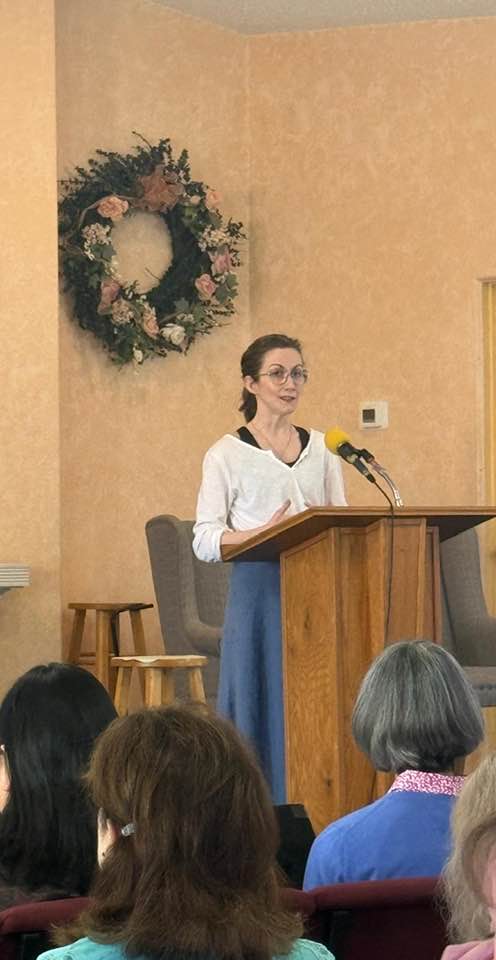
Good afternoon, Blogging Family! Last weekend, I was grateful to be one of the guest speakers at a women’s conference in Pacheco, CA, co-hosted by Foothill Baptist Church and Christ Church of All Nations (Ivan’s parents’ church). It was such a privilege to collaborate with the other speakers and meet women from other churches and backgrounds. It was also a growing experience for me, since the two areas that I am most comfortable with are counseling and prayer ministry (both one-on-one settings). Although I do love to teach music and writing and we have been blessed to share our accident story quite a bit in larger contexts, this was the first time that I prepared a message and spoke on a topic that was not related to our accident.
God was very faithful, and throughout the process I discovered that a lot of the skills I’ve developed in both teaching writing and preparing for counseling sessions were similar to what I needed to prepare a conference session. The similarities were studying what the biblical text said, consulting other passages from Scripture that shed more light on it, looking for relevant commentaries, and prayerfully discerning my own thoughts about the passage. Perhaps most important was praying that the Lord would use the passage to minister to (and convict!) my own heart during the preparation process, and also praying for the hearts of everyone who would attend. My conclusion after going through this process (although I admit that I am still very new to it), is that there is not a huge difference between preparing for a conference talk and counseling, except that I would say delivering a conference talk currently feels more disorienting to me.
In counseling, I can dialogue with the other person and try my best to sense by their tone of voice, facial expressions and verbal responses how they might be processing what I am sharing, or if they would benefit from a different approach. While this does not necessarily guarantee that every session goes well, and it is only God who does the transformation in a person’s heart, it does frequently provide a real time gauge to help me discern if the direction I am going is actually beneficial or if I need to change courses.
In contrast, delivering a conference talk does not allow this kind of real-time feedback and requires much more faith that God is the One who will work through (and in spite of) me, and that ultimately He has promised His Word never returns void, no matter how little I may know about each person in the room or how imperfectly I may communicate.
This past Saturday, I was grateful to speak on the life of Abigail. Meditating on how she wisely responded to a very complex situation (a foolish and ungodly husband and a future king who was sinfully angry) convicted me about 1) how much I take my own healthy marriage for granted and 2) how much I struggle to live out her example of honoring Nabal’s and David’s God-given positions. Far too often, I use other people’s sin as an excuse to justify my own. In Abigail’s case, God rewarded her willingness to submit to the position rather than fixating on the person who was not living up to his position. Her humility brought conviction to David’s heart, saved the lives of her male servants, and, after her husband’s death, gained her what we can guess was likely a better life as David’s wife.
Abigail could have sought to preserve her own life by running away when her servants brought her the news of David’s impending wrath, and perhaps she might have succeeded. However, by doing this she would have become implicit in the murder of Nabal’s servants, at least some of whom were not as wicked as Nabal himself (vv.14-17). By seeking to dissuade David from his murderous design, Abigail identified herself with Nabal’s guilt in order to intercede for him. This put her in danger since she did not know how David would respond. As Nabal’s wife, she was also aware that he did not deserve this intervention and she would not receive any personal benefit, except the benefit of honoring the Lord and the husband He had sovereignly allowed into her life, and potentially saving some innocent lives if she succeeded. It’s also worth noting that God’s justice in punishing Nabal was much more accurate than David’s sinful anger would have been. By eliminating Nabal through an adverse health event (perhaps a heart attack or stroke), God only punished the person who needed punishing. He also simultaneously freed Abigail and Nabal’s servants from their oppressive situation. David, however, was planning to wipe out “every male” belonging to Nabal, which would have included at least some innocent servants.
I’d like to close with this New Testament admonition and encouragement. It’s how I ended my conference talk Saturday I think it encapsulates the story of Abigail, Nabal, and David – and God’s intervention in all their lives so perfectly, I also hope it can encourage you all with whatever you may be facing this week!
Do not be deceived: God is not mocked, for whatever one sows, that will he also reap. For the one who sows to his own flesh will from the flesh reap corruption, but the one who sows to the Spirit will from the Spirit reap eternal life. And let us not grow weary of doing good, for in due season we will reap, if we do not give up. So then, as we have opportunity, let us do good to everyone, and especially to those who are of the household of faith.
Last week I turned 33. One of the most obvious lessons from my accident that I remember every year was that we cannot take life for granted and only God knows what a day may hold. But this birthday was particularly significant because I was 23 when I was hit by the car. So it was even more impactful to consider both how much we’ve been through in the past ten years and how much God has restored. Psalm 103 is one of my favorite psalms:
Bless the Lord, O my soul, and all that is within me, bless his holy name! Bless the Lord, O my soul, and forget not all his benefits, who forgives all your iniquity, who heals all your diseases, who redeems your life from the pit, who crowns you with steadfast love and mercy, who satisfies you with good so that your youth is renewed like the eagle’s.
I think it’s significant that in addition to being my birth month, March is also TBI Awareness Month. Although God has done amazing healing in my life, He’s also allowed the brain injury to remain. As a counselor, I describe it as the “context” for many practical and relational issues we navigate in daily life. The good news is that there are now long stretches of time when we’re not acutely aware of the presence of TBI. However, when I increase my activity or encounter certain complex relational challenges, we hit seasons that require a lot of wisdom and skill to navigate in a way that is healthy for both of us. Re-learning to drive, periodically planning events for writing and music, and increasing my ministry capacity at church are examples of relatively recent situations that have reminded us of my underlying TBI and are still challenging us to grow toward God and each other.
I’d like to close with an excerpt from a joint blog post we wrote for my publisher, Shepherd Press, in honor of TBI Awareness Month:
Ivan: God has grown me in many ways over the last nine years. Just as He sovereignly introduced TBI into Grace’s life, He also added the role of caregiver into mine. I’ve seen how conflating the roles of “husband” and “caregiver” can cause confusion and even hurt. Through experience, Grace and I have grown in seeking God’s wisdom to discern which aspects of our interactions have been affected by TBI, and which have not. Through this process, our desire has been to view each other more and more as God does, because He looks not at outward appearances but at the heart (1 Samuel 16:7). TBI can distort certain daily interactions depending on the location and severity of the injury, but it cannot change that a person’s heart has already been filled with God’s Holy Spirit. Even in the middle of a TBI storm, God always holds His children’s hands securely in His. May He find childlike faith in each of our hearts as we walk with Him through TBI and beyond!
Grace: Before my accident, I was incredibly performance-driven. On the positive side, this helped me to excel at music, academics, and work, but it also deeply affected the way I related to God and people. While I wish I could say this is no longer a struggle for me, I am very grateful for how the Lord has used TBI to strip away many worldly achievements on which I used to build my identity. My years of recovery taught me to cry out to Him in prayer and also depend on Him in daily life in a deeper way than I believe would have occurred if I had continued on my former trajectory. He has also used it to reveal the motivations of my heart, and is continuing to reveal people and pursuits that I am worshiping before Him. While He graciously blessed me with a much fuller recovery than was initially expected, my residual TBI deficits remind me that He is the only One Who is truly unlimited. He is jealous for the Spirit He has placed within me, and He is always faithful to draw near when I cry out to Him. He draws near based on His character and promises, not my performance (James 4:5-8).
Thank you for taking this brief journey with us! Whether or not you have been impacted by TBI, we pray our story will strengthen your faith and help you grow in your walk with the Lord!
Hello Blogging Family! Thank you all so much for your prayers and concern! I’m finally back to normal typing, and wanted to share a personal “thank you” as well as my own thoughts on the past couple of weeks.
Although we continue to be extremely grateful for just how faithful and powerful the Lord has been to restore so much of my life, this incident has reminded me that I’ve started to take certain parts of recovery for granted. On the bright side, it’s also been a sweet demonstration of all the love and support we continue to receive from our online community whenever there is a health-related update! ❤
As I consider the progress that I may have begun to take for granted – or push a little too far – working in the kitchen is one of the first things that comes to mind. Every time I’ve told my version of this latest incident and started with, “Well, I was opening a can one-handed…” I’m struck by how unwise this sounds. Although I’ve been opening cans for several years now, I’m realizing that it’s God’s mercy and protection that I made it this long without an accident.
While Ivan does most of the truly dangerous kitchen work at our house, I admit that my limitations with my left hand tempt me to feel insecure when I consider what other wives do for their husbands. This often prompts me to test my limits to see if I could be doing more. Hence my one-handed can-opening career. But the past couple of weeks have reminded us that when my experiments go south, I need significantly more help from him than if I focused on doing what we know I can do safely and well.
On the subject of help. the past couple of weeks have been a sweet reminder of how much Ivan is willing to help and how much my guilt for asking him is self-imposed. On the drive home from the hospital he began peppering me with questions about everything I would need help with now that I was down my right hand – including getting dressed. While I nixed that particular suggestion, the heart behind it was truly precious, and continued to remind me of how Ivan has always been willing to do whatever needs to be done to care for me.
And I did find myself humbled the following morning when we embarked on our two weeks of wound care. Although I knew I would need some help given that I had relatively incapacitated my dominant hand, after everything I’ve been through I pride myself on being rather tough and low maintenance. I laid everything out and read all the instructions, only to be hit by a wave of nausea when we removed the bandage. Maybe it’s been too many years since our last significant incident, or maybe there was something different about this cut (Ivan spared the gory details in his post), but I found myself unable to do anything except look away and pray while he did all the wound care. So this too was a poignant reminder, not just of Ivan’s willingness to help, but also of the Lord’s faithfulness and enabling power in all the trials we’ve been through in the past. I am more aware than ever that the grit I used to think was part of my personality is really an enabling grace God can give and remove as He sees fit. I’m very grateful for when He does choose to give it. When He does not, this causes me to depend on Him more closely and also be more grateful for the help I receive from others.
I’d like to close with Psalm 46, which my discipleship group recently memorized. The application question the week before my can-opener incident was “How are you going to apply this psalm to daily life?” At the time I’d talked about using it as a framework to pray for others and also praise God’s sovereignty over all our lives. I couldn’t imagine this application would get VERY real just a week later. In the ER, I was desperately looking for something to which I could fix my attention when it was time to get the stitches put in. Reciting the psalm in my mind and rehearsing the Lord’s presence and power transformed what would have been an otherwise extremely disconcerting few minutes for me. Hopefully this can also be an encouragement to all of you who have a practice of memorizing Scripture, or are considering starting this journey!
God is our refuge and strength, a very present help in trouble. Therefore we will not fear though the earth give way, though the mountains be moved into the heart of the sea, though its waters roar and foam, though the mountains tremble at its swelling. Selah
There is a river whose streams make glad the city of God, the holy habitation of the Most High. God is in the midst of her; she shall not be moved; God will help her when morning dawns. The nations rage, the kingdoms totter; he utters his voice, the earth melts. The Lord of hosts is with us; the God of Jacob is our fortress. Selah
Come, behold the works of the Lord, how he has brought desolations on the earth. He makes wars cease to the end of the earth; he breaks the bow and shatters the spear; he burns the chariots with fire. “Be still, and know that I am God. I will be exalted among the nations, I will be exalted in the earth!” The Lord of hosts is with us; the God of Jacob is our fortress.