Global Reflections after Reformation Sunday

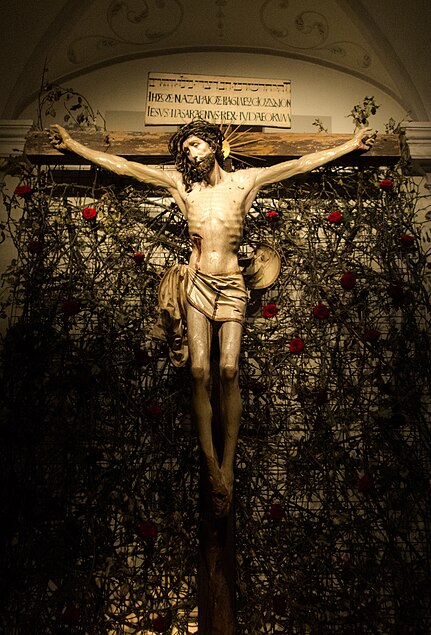
This is a statue from Melk Abbey in Austria.

Hello, Blogging Family! I hope you had a blessed Reformation Sunday yesterday. This holiday has impacted me differently after our trip to Central Europe this summer. I’ve always been a voracious student of history, art, and music, and was excited to visit some of the countries that were crucial to classical music, the World Wars, and church history. I realized that Austria, Slovakia, Hungary, and Czechia are either Catholic or secular today, but I also knew that some of them had either been instrumental in the original spread of Christianity across Europe or the Protestant Reformation. They are still home to some of Europe’s oldest and most beautiful cathedrals. But I wasn’t prepared for the spiritual landscape we encountered during our trip.

We were blessed to tour cathedrals in each country, as well as Melk Abbey in Austria. Melk is a Benedictine monastery that was founded in 1089 and is famous for its ancient library as well as the dignitaries that have visited (including Mozart, Napoleon, and Empress Maria Theresa). The art and architecture in all these locations exceeded my expectations, and at Melk I especially loved seeing some medieval manuscripts I’d studied in facsimile during grad school at SCAD

But I was also deeply saddened as I pondered the Jesus portrayed by this art, and imagined how different my life would be if this were the only Jesus I knew. Everywhere we went, the representations of Christ we saw were effeminate and dead. He was typically either nailed to a cross, or being tended by his mother or saints after his death. While it’s essential to spend time remembering how much Jesus suffered for our sins, our hope of eternal life comes from the truth that he is a risen, powerful Savior who conquered death and is alive and working today (1 Cor. 15:12-28).

This focus on death wasn’t just limited to Jesus. At each cathedral, we were greeted by a list of saints’ relics that were either available for regular viewing or on “special occasions.” These ranged from finger bones and scraps of clothing, to a martyr’s tooth and jawbone that had been encased in jewels. When I asked our guides what they thought about the churches and relics they were representing, their answers were insightful. Some responded, “This is the church I was baptized and married in!” although whether they still attended was less forthcoming. Others highlighted that relics do not fare well when subjected to DNA testing. 

But one theme was universal: whatever the guides’ personal feelings about their churches, everyone agreed that the Protestant reformation was an inconvenient blip that had been decisively addressed by the Counter-Reformation hundreds of years ago.

I’ve had several months to reflect on this emphasis on death and the impact it seems to have had on the countries we visited, as well as do more research to compare data with the spiritual climate we sensed. For example, the Austrian embassy reports 3.8% of the population to be Protestant/evangelical, but most missions agencies believe this number is closer to 0.5%. Few Austrians actually attend the Catholic churches into which they were baptized. In recent years, New Age practices have begun gaining popularity with those searching for some form of spirituality. 

I think there are many factors at work here, but one of them could be that we are highly influenced by the images we absorb as children. If we only see Jesus portrayed as dead and powerless, and are taught instead to seek the intercession of dead saints and professional clergy, to whom we also have limited access, what immediate or eternal hope does this offer? Deep down all of us know we will never be good enough to earn God’s favor, and how much confidence can we really put in humans who left this earth centuries before us?

As protestants in the United States, it’s easy to dismiss Reformation Sunday as the anniversary of a German monk nailing a theological treatise to the door of a church on the other side of the world. But visiting these cathedrals in Central Europe and witnessing the functional outworking of the Counter-Reformation has reminded me that Reformation Sunday represents so much more than just that. It represents returning to an understanding that we come to God through faith alone in a living, powerful, resurrected Savior, who made a way for us to speak directly with God in prayer without human intermediaries. It represents the freedom – indeed the responsibility – to read God’s Word for ourselves instead of relying on “professional Christians” like priests to tell us what God says about himself. And through these reformations of speaking to and hearing from God ourselves, Reformation Sunday represents a renewed understanding that God is not only immediately accessible, but he wants to hear from us and speak to us, each and every day.

I hope these reflections will remind you of privileges that, if you’re like me and grew up in a protestant church, we can often take for granted. I also hope that if countries like Austria, Czechia, Slovakia, and Hungary haven’t been on your prayer radar until now, you will join me in praying that God will pave the way for his gospel to gain more and more traction in these countries. He may even have a role for you or me to play!

Seeing God: Lessons from Matt Redman

One of my favorite names for God is El-roi, or  “the God who sees me.” (Gen. 16:13). This name for God, and the story of God dealing tenderly and patiently with Hagar, a woman who was a foreigner, slave, and surrogate mother, has become increasingly precious to me since my accident. God uses a variety of ways to show us that he sees us, including the compassion of our brothers and sisters in Christ. Last week was a sweet reminder of what it was like to feel seen in the early days of my recovery, and also an opportunity to watch that gift be passed on to the next generation. 

Last Monday, we took some worship team students from Valley Christian down to BIOLA to spend a couple of days observing chapels and audit a songwriting workshop taught by Matt Redman. This trip was especially meaningful because Ivan taught the three Redman boys piano when we lived in Southern California. Most parents keep their relationship with their children’s music teacher strictly professional, so we were really surprised the Redmans took an interest in how we were doing after my accident – especially since I’d never met them when it happened. Once I got a little stronger, they even let me come along to lessons to have a change of scene. This was incredibly thoughtful, since public spaces were still too crowded and noisy for my brain injury to tolerate, which meant I stayed in our apartment most of the time. 

I was incredibly nervous the first time Ivan brought me to a lesson. I was clutching two books and a journal, determined to vanish into a shadowy corner as soon as I got through the door. The Redman’s house was devoid of shadowy corners. Furthermore, I was not the piano teacher’s recovering tagalong, but someone they actually wanted to see. Matt’s wife, Beth, sat  and talked with me quietly in the living room for as long as I could tolerate, while also being sensitive to what Ivan must have mentioned about my struggles with fatigue and overstimulation. On the drive home, both Ivan and I were taken aback by this turn of events. However, after a few days of bewilderment I decided they were just being hospitable and I shouldn’t push my luck. The following Saturday I fortified myself with books and journal – and we repeated the entire ritual. 

After a few weeks I finally embraced that the Redmans weren’t viewing me as a charity project, or even trying to maintain some sort of public image. They were doing what they did because they loved God, and I loved God, and that commonality was far stronger than all our differences. Beth’s choice to give up a large chunk of her Saturday mornings gave me something to look forward to every week and provided a huge source of spiritual encouragement, as well as a rare opportunity to feel seen as a normal human being in spite of all the medical appointments that kept us scrambling Monday-Friday. 

Last week, as we were sitting in the songwriting clinic with our wide-eyed high schoolers and a handful of BIOLA undergrads, I was deeply encouraged to hear Matt share that his primary calling was not to help people sing better, but to help people see God better. God is a self-revealing God, he shared, and no matter what our vocation is, our calling is to live in such a way that people can see God’s character in what we do. For Matt, that means writing songs that reflect biblical truths and also give space for congregations to respond to those truths. I happen to be a writer, so my application is similar, although I don’t have to worry about whether my words work with a melody. But for all of us, I think the principle of helping people see God through our lives stems from one of my favorite verses, 1 John 4:19. “We love because he first loved us.” God saw us first and loved us first, and is always forever seeing and loving us through the death and resurrection of his Son, Jesus.  And if we are saved, it is our gratitude for this supernatural seeing and loving, and our reliance on his Spirit, that empowers us to deeply see and deeply love those around us.

Open the Windows

Ivan: Hello everyone! This picture was taken when Grace and I had the wonderful opportunity to speak at Wheaton College. Though the hallway itself is nondescript, its juxtaposition of light and shadow stood out to me. The metaphor of light and darkness is also one of the most common themes throughout the Bible: “God is light, and in him is no darkness at all” (1 John 1:5). Sin is often portrayed as darkness. In fact, Jesus admonishes us not to live in the dark, but to step into the light: “For everyone who does wicked things hates the light and does not come to the light, lest his works should be exposed. But whoever does what is true comes to the light, so that it may be clearly seen that his works have been carried out in God” (John 3:20-21).

Let’s build on this metaphor: Imagine that your heart is a house with many rooms. Most of the rooms have open windows, with curtains fluttering in the breeze and sunshine pouring in. But there is a room – or two or three – with locked doors; the curtains are drawn, and the windows shut. These rooms are filled with darkness.

We intellectually know that God sees all things, including the depths of our hearts; we also know that the life of the believer should be a life of total surrender to our Lord and Savior. And yet are there certain rooms in our hearts that we’re trying to keep closed off to God?

What would it look like if we truly opened all the doors and windows in our hearts to God’s light and love? What would it look like if we kept absolutely nothing from God, if every aspect of our lives were fully lived in the light of God’s mercy and grace? What a life that would be. May we daily step in to His light, encountering His holiness and living in His power and love.

Grace: When I consider why I delay confessing sin or temptation to God and people, my excuse is usually fear. Although I know my sins are forgiven because of Christ’s work on the cross, depending on the situation it can be very hard for me to shake the idea that I have disappointed God – again – especially after all he has done for me. And when it comes to people, it is even harder to predict how they will respond to my admitting sin or weakness. Sometimes they respond with grace and kindness, and sometimes, sadly, they don’t. When they don’t, that makes it even more challenging to remember that God himself is not angry with me, because Christ’s work on my behalf is already complete. The truth is, the only thing that strains my relationship with God is my own prideful fear of being honest. But God has promised that when we confess our sins “he is faithful and just to forgive us our sins and to cleanse us from all unrighteousness” (1 John 1:9). While none of us can control the human response to our coming into the light, we can trust what God has told us about himself, and pray for the discernment to see the difference between flawed human reactions and the unlimited forgiveness and mercy that is always available in Christ.

“There is no fear in love, but perfect love casts out fear. For fear has to do with punishment, and whoever fears has not been perfected in love. We love because he first loved us.”

1 John 4:18-19

Jesus, Our Living Water

Dying of thirst is one of the worst deaths I can imagine, both for its duration and for the psychological torment that accompanies it. Although this is a real threat for some parts of the world, very few of us in the United States spend much time thinking about it, unless we work in emergency medicine or forget to pack a water bottle when we’re heading to the gym. 

Sometimes I wonder if this lack of exposure to real thirst has made Jesus’ promise to give us “living water” in John 4:10-14, or David’s cry to God from “a dry and thirsty land where there is no water” in Psalm 63:1, a bit harder to appreciate when we’re doing well, or cling to when we’re struggling.

“But whoever drinks of the water that I will give him will never be thirsty again.The water that I will give him will become in him a spring of water welling up to eternal life.”

~John 4:14

In God’s sovereignty, in the very early days of my accident, I did experience what it was like to believe I was dying of thirst. Although my body was receiving adequate nutrition, first through an NG tube and later through a stomach tube, I was not allowed to eat or drink for several weeks. My family assumed that I would “feel” fine since my nutritional needs were being met, but we quickly discovered that was not the case. Doctors explained that, unless food and water pass through your mouth, your brain believes you are thirsting and starving to death. I became obsessed with begging for food, but especially water. It didn’t matter how often people explained that it wasn’t safe for me to eat or drink, and that my body was receiving everything it needed –  nothing could assuage my overpowering desire for a drink. Even sleep didn’t provide relief. In my dreams, I was either dying of thirst or taking one long, refreshing drink after another. I also became a bold-faced liar, assuring whoever happened to be in the room that I had “just” gotten permission to start eating and drinking again. Somehow, no one ever believed me. 

As torturous as this experience felt, I realize it is still light-years away from the moment-by-moment pain and fear faced by people with truly restricted or zero access to water or food. However, knowing a little of what it’s like to experience serious thirst psychologically has helped me understand better both what David was describing when he cried out to God, and what a rich promise Jesus makes when he offers us “living water.” Recently, it’s also been causing me to reevaluate how I “expect” God to come through for me when I’m in the midst of a trial. Do I have one outcome I’m praying for (in this example, receiving literal food and water)? And in fixing all my hopes on this outcome, am I missing God’s actual provision (the “food” coming through the NG tube)? 

Contrasting my own assurance that I was perishing with the truth that I was actually receiving everything I needed, as well as observing how this attitude plays out in my life today as I still struggle to embrace that what God gives me is sometimes very different from what I want or believe I need, reminds me that translating “head knowledge” about God to “heart knowledge” that transforms my everyday walk is an ongoing journey that will last until Heaven. May we trust God’s faithfulness to complete the good work he is doing in all of us!

A Fruitful Abiding

Recently, God impressed a single word on my heart: Abide. I’ve heard the word all my life, but I decided to look it up since I’d never given it much thought. According to Merriam-Webster, “abide” means “ to remain stable or fixed in a state.”

As I’ve been pondering this call to abide, I’ve also been reminded of Old Testament verses like “Be still and know that I am God,” (Psalm 46:10), and “In quietness and confidence shall be your strength” (Isaiah 30:15). This past season has been anything but quiet for me, with the publication of Hello, God and our recent trip to Central Europe. One event represents the culmination of a year of praying, writing, and seeking the Lord’s will, and the other is a continuation of how God’s healing enables us to travel internationally, something we once considered impossible. But in another sense, both events intensify the temptation to rely on my own strength, look away from the Lord, and measure my success by human metrics rather than God’s.

That’s why I think the Lord’s reminder to abide is so tender and timely, and I hope sharing it will encourage you as well. Summer can be a time for rest, but it can also be a time for running after even more activities than we pursue during the rest of the year. I’m becoming more and more convinced that being still in the Lord’s presence precedes truly knowing He is sovereign over every detail of my life in my heart as well as my head.

I also think that this theme of quiet confidence in God’s power ties in to Jesus’ sermon on abiding.  

“Abide in me, and I in you. As the branch cannot bear fruit by itself, unless it abides in the vine, neither can you, unless you abide in me.  I am the vine; you are the branches. Whoever abides in me and I in him, he it is that bears much fruit, for apart from me you can do nothing.  If anyone does not abide in me he is thrown away like a branch and withers; and the branches are gathered, thrown into the fire, and burned.  If you abide in me, and my words abide in you, ask whatever you wish, and it will be done for you.  By this my Father is glorified, that you bear much fruit and so prove to be my disciples.”

John 15:4-8

Jesus’ words comfort me because the “abiding” he desires is not measured by anything I do on my own, like meeting the standards I set for myself or others set for me. Rather, to borrow the definition of “abide” I shared earlier, he’s looking for how stable I remain in reading his Word and in prayer. And if I am giving him preeminence in these ways, then I can trust that he will help me produce the fruit he desires. 

May we all continue to grow in our desire to be still, know, and abide this summer!

Of Chocolates, Emperors, and God’s Love

Hello Blogging Family, I hope you all had a great 4th of July yesterday! This picture was taken at the Heindl chocolate factory in Vienna, where Grace and I got to participate in a chocolate-making workshop on our recent school trip. Perhaps Heindl’s most famous products are the Mozartkugel and Sissi Taler, chocolates named after the famous Classical composer and Empress Elisabeth of Austria. I hadn’t heard of Empress Elisabeth before, but discovered that she is very popular in Austria, perhaps the most beloved figure from the Habsburg dynasty.

Thinking about the freedoms we enjoy – and expect – today has provided an interesting contrast between the history we learned on our trip and how we think about God. During our tour of Central Europe, our local guides taught us about many different rulers: kings, emperors, princes. They spanned multiple periods of history, from medieval times through World War I. Some ruled well, others poorly; some were honorable, others sadly not.

The Bible describes God as a king. King David writes in Psalm 103:9, “The Lord has established his throne in the heavens, and his kingdom rules over all.”

But what kind of king is God? As Grace and I learned about the earthly rulers who came and went in the Austro-Hungarian Empire, it was hard to imagine that even the most noble and selfless of them would willingly sacrifice themselves for their people. Instead, they tended to hold on to power and make sure that others couldn’t challenge them!

Jesus did the opposite. Being in fact “King of Kings and Lord of Lords” (Revelation 19:16), He chose to leave His heavenly throne and enter our broken world (Philippians 2:6-8). Why? To redeem us from sin and death, to reconcile us to Himself.

This in itself is more than wondrous, but the love of God goes deeper still: Jesus didn’t die in our place because we were already His people; He died in order to make us His people. In fact, we were His enemies! This is truly unheard of. Which of us would lay down our lives (literally) for those who oppose us, mistreat us, mock us? Which of us, given supreme power and authority, would give it all away and die in the place of our enemies?

Friends, this is exactly what our Lord Jesus did for us. The Apostle Paul writes:

“But God showed his great love for us by sending Christ to die for us while we were still sinners. And since we have been made right in God’s sight by the blood of Christ, he will certainly save us from God’s condemnation. For since our friendship with God was restored by the death of his Son while we were still his enemies, we will certainly be saved through the life of his Son. So now we can rejoice in our wonderful new relationship with God because our Lord Jesus Christ has made us friends of God.”

Romans 5:8-11

We were God’s enemies, yet He died in our place to make us His people, His family, His friends. Each of us must decide how we will respond to God’s offer of forgiveness and redemption. Will we remain His enemies? Or will we, in wonder and gratitude, humbly bow our knees in worship?

As the lyrics of the song “Amazing Love,” say:

I’m forgiven because You were forsaken
I’m accepted, You were condemned
I’m alive and well, Your Spirit is within me
Because You died and rose again

Amazing love, how can it be
That You, my King, should die for me?
Amazing love, I know it’s true
And it’s my joy to honor You
In all I do, to honor You

May we serve our King with gratitude and joy ☺️

A Gospel-Centered Mother’s Day

The implacable Southern California sun refracted off our bone-white driveway and stung my eyes. Sweat clung to the inside of my tank top. “Mom -” I hesitated. “- where do you find strength to keep going under pressure?” 

My family had endured its rough seasons over the years. All my grandparents passed away before I turned twenty. Although we lived hundreds of miles away and my mom homeschooled me and my sister, she traveled to Georgia as much as she could to help with their care. None of us knew it yet, but a few years later she would move in with Ivan and me for five months after my accident.

What already struck me as a 19-year-old was that Mom never complained about the constant demands of caring for others. I’ve pondered her answer to my question as Ivan and I have walked through our own trials over the years, and I’d like to share it with you all in honor of Mother’s Day.

“Well,” she replied, after a moment’s pause. “God helps you find beauty in the things you love.”

I was startled. Through my parents’ ministry, I’d already encountered plenty of un-beautiful situations like death, miscarriage, and divorce. As I’ve contemplated Mom’s words and learned more about how God sees us through the gospel, their meaning has taken more shape.

We live in a world that has rejected God. But God in his mercy still allows our world to be beautiful and showers us with common grace, whether or not we acknowledge its Source (Acts 14:17). 

What’s more, once we surrender to Christ, when God looks at us he chooses to see his precious, perfect Son, rather than our sinful corruption:

For he chose us in him before the creation of the world to be holy and blameless in his sight. In love he predestined us for adoption to sonship through Jesus Christ, in accordance with his pleasure and will— to the praise of his glorious grace, which he has freely given us in the One he loves.”

Ephesians 1:4-6

This does not mean that God glosses over our brokenness. Rather, he grants us positional holiness, while patiently completing the good work that he began the moment that we accepted Christ (Phil. 1:6). So we exist in an “already” and “not yet” state of grace. 

What about those of us called to love people who are not walking with the Lord? I think we can ask God for strength to not grow weary in doing good, and for grace to see everyone as made in the image of God, no matter how much sin may distort that image. God will reward us at the proper time if we do not give up, whether we see that reward in this life or in Heaven. Although it’s easy to agonize over hypotheticals – “Should I have used a better illustration? Would that Bible verse have been more impactful?” – I continue to grow in the awareness that only God’s supernatural intervention can awaken us to our need for salvation (Eph. 2:4-5). All he asks is for us to be instruments ready for him to use, and leave the results to him. 

When Mom encouraged me to find beauty in what I loved, I don’t think she was advocating for ignoring brokenness. But I do think her outlook reflected hope that God is transforming those of us who have placed our faith in Christ into his image, however infinitesimal that progress may seem at times. May this give us great humility and great peace as we seek to grow in Christ and love those around us!

The Battle to Believe

“For God gave us a spirit, not of fear, but of power and love and self-control.”

The verse’s assurance knocked the breath out of my shivering, twelve-year-old body that Sunday morning. Suddenly everything –  the chilly sanctuary with its stiff wooden pews and the filigreed pocket Bible that was the light of my preteen eyes – vanished in the blazing glory of the Apostle Paul’s declaration. 

Can this really be true? I faltered in the face of my hitherto unshakable fears: How would I score at my next violin competition? Would “normal” kids ever accept me since I was homeschooled and loved literature and classical music? What’s more, my fears were founded on reality. I could perform poorly, and I’d experienced my share of social rejection. But God, through the Apostle Paul, was promising me power, and love, and self-control in spite of my experiences. And God never lied. How would I respond? 

That morning was the first time I remember encountering 2 Timothy 1:7, but since then God has reminded me of that promise at crucial moments when I’ve felt like I was about to be overpowered by fear. Perhaps my preteen troubles seem trivial to us adults, but we can all remember how the hardships we experienced as young people seemed like the pinnacle of suffering. It’s only with additional life experience (and cognitive and emotional development), that we gain perspective to evaluate those circumstances in a more holistic light.  

The same is true of our suffering as adults. Perhaps an illness, or lay-off, or relational fracture that seemed almost beyond our capacity to endure five years ago looks different now that we have seen God sustain us over time and discerned what he was teaching. Each time he brings us through a trial, it should increase our confidence in his faithfulness for the next trial. 

I say “should” because in my own life, I’ve discovered this process is not always linear. Severe physical suffering has been a personal theme for many years, and I’ve been blessed that God had helped me to cling to what I know to be true of him and his Word during those times. But as God graciously removed the suffering I endured from uncontrolled seizures, I’ve been confronted with some relational disconnects that the seizures camouflaged. And I’ve discovered that, because of my brain injury, painful emotions can shake me much more deeply than physical suffering ever did. Although my verbal skills are high, my rational and emotional processing can become disconnected when I perceive something’s wrong or there’s actual conflict. The result is that even though I know certain things are true about God, his Word, or even a particular person, it can be extremely hard to overcome the hurt once it’s imprinted. 

I share this struggle because, while not everyone has a brain injury, I believe we all find ourselves in similar situations at some point. There will come a time for all of us when what we know about God and his Word – and possibly the person in front of us – doesn’t line up with how we’re feeling. And we’ll discover our feelings seem impossible to overcome. Like my twelve-year-old self on that Sunday morning, we’ll be confronted with the question, “Now what?” My preteen fears didn’t vanish overnight. I memorized 2 Timothy 1:7 and repeated it over and over again before I saw measurable change. I’m still in the trenches of a daily battle to believe that God’s Spirit of “power, love, and self-control” is fully available to me every moment of every day, no matter what the day may hold. The key is to keep asking God for his power, trusting that he never gets tired of my requests (James 1:5), and that he delights to give good things to all who ask him (Luke 11:13). That is who he always has been, and that is who he always will be. Will you join me? 

Immanuel, Revisited

“O Come, O Come, Immanuel,” is one of my favorite Christmas carols. A musical child, I was first arrested by its haunting melody.  Later, its plaintive lyrics resonated with my teenage contemplations. As an adult, I’m even more captivated by these elements and also heartened by the final stanza’s call for Christ to return and right the world once and for all.

But as I consider what “Immanuel” – God with us  – has meant to me over the years, I’ve also come to realize Mary and Joseph’s experience of God’s presence was likely different from what we imagine.  

The gospel of Luke tells us that Joseph and Mary traveled to Bethlehem to comply with a Roman census, where Mary gave birth to Jesus in a stable because the inns were full. While this chain of events fulfilled the prophecy that Jesus would be born in Bethlehem, there’s no prophecy stating Jesus had to be born in a stable. 

Mary got an angelic message announcing she would bear the Savior of the world, and Joseph got a dream reassuring him that Mary’s child was the Son of God, not the result of her infidelity. But neither of them got additional information on the specifics surrounding Jesus’ birth. Instead, as Mary’s time approached, they found themselves faced with a 90-mile trek teeming with wild animals and robbers, not to mention the possibility that Mary could give birth along the way. 

Furthermore, have you considered the social pressure they must have endured throughout Mary’s pregnancy? Unwed motherhood carried the death penalty in biblical times. Although Mary and Joseph could infer from their angelic messages that Mary’s life would be spared, her survival wouldn’t have protected them from severe stigma.

Giving birth in a stable after an arduous, 90-mile trek and nine months of false accusations (or worse), must have felt like rock bottom for Joseph and Mary, even if they’d been told their baby would be the savior of the world. It’s also interesting that as far as we know they never saw the “heavenly hosts” that appeared to the shepherds, or the star that guided the wise men. Nevertheless, I’m sure that visitors who joyfully acknowledged their baby’s identity were a welcome relief.

But it’s also relevant to note that the historical story of Joseph, Mary, and Jesus doesn’t end at the manger. The gospel of Matthew tells us that the wise men alerted King Herod to the fact that there was potentially a new “king of the Jews” on the scene, and he ruthlessly murdered all baby boys under 2 years old in Bethlehem.

But what did the massacre mean for Joseph and Mary? Although Matthew tells us an angel alerted Joseph ahead of time, and the family escaped to Egypt, have you imagined what their exile must have been like? They’d just endured the stigma of an unwed pregnancy and given birth in horrific conditions, only to receive unlooked-for encouragement through supernatural intervention. Just when things were starting to look brighter, Mary and Joseph found themselves fleeing to a foreign country – and not just any foreign country, but one with almost a thousand years of animosity toward their own. A place where no one spoke their language, let alone worshiped their God. Mentioning their son was going to be the Savior of the world was off the table.

My point in highlighting these aspects of the Christmas story is not to make things sound unduly negative, but to suggest that our concept of what “God with us” means could be broadened. Mary and Joseph had at least four direct supernatural encounters (the visit from the angel Gabriel and Joseph’s three dreams), and the incredible privilege of watching Jesus grow from infancy to adulthood. But these supernatural events occurred relatively close together, and we know little about the rest of their lives.

In my own life, although God has worked supernaturally twice, I still deal with physical limitations and relational stressors that have made recent months challenging. When we’re discouraged, it’s easy to focus on the high points – whether the ones we read about in Scripture, or see around us – and compare our assumptions of God’s presence in others’ lives with our experience of God’s presence in our own. The truth is God is always with us, whether we feel him there or not. 

Luke 2:19 tells us, “But Mary kept all these things in her heart, and she thought about them often.”

Most likely, Jesus looked and acted like a regular baby, at least initially. Raising her first child in a hostile foreign country couldn’t have been easy.  But Mary had seen God’s power displayed unmistakably, and she was committed to renewing her mind. 

Whatever this season holds for each of us, I pray we will make a practice of calling to mind what God has already done, both as revealed in Scripture as well as in our own lives and the lives of those we love.

O come, desire of nations, bind
In one the hearts of all mankind
Bid Thou our sad divisions cease
And be Thyself our King of peace

Rejoice! Rejoice! Emmanuel
Shall come to thee, O Israel

Where the Pressure Lies: Reflections on 8 Years

Today marks the eighth anniversary of my accident. Comparing December 3rd, 2024, with December 3rd, 2023, I can honestly say that God has radically transformed my life. Today, I no longer have seizures or experience severe spiritual warfare. I recently got my driver’s license. I continue re-learning to play violin. Although I still face severe migraines and other neurological deficits, my quality of life looks drastically different from what I could have imagined 365 days ago. But these divine interventions also beg the question, What about the suffering and uncertainty we endured during those first seven years?

From a human perspective, it would have seemed more humane for God to heal my seizures immediately, or at least shortly after they started, rather than allowing us to agonize over possible causes and cures for so long. Not to mention the social isolation we experienced due to my severe light sensitivity. Since I’m not God, I can’t say with certainty why he chose to act the way he did, but I have a few guesses: 

  1. Exhausting our human medical options forced us to look to God alone for our “daily bread,” whether that took the form of healing, partial improvement, or just the grace to endure joyfully no matter our outward circumstances. 
  2. Our intense suffering increased our empathy for others’ hidden hurts. Seizures are invisible unless they’re happening, and brain injury deficits and stroke fatigue are even more subtle. They may not manifest until hours after I’ve been pushed past my limits. Depending on how far I’ve been stretched, I may have to spend a day or two recovering. These “invisible” challenges increased my awareness that others might also be experiencing secret pain, whether physical or emotional.
  3. Those years of suffering drove home that God is both sovereign and kind, no matter how he chose to work in our lives. While we knew he could end our suffering at any time, the most straightforward path seemed like a medical intervention. However, we also knew a couple of people with seizures who were unable to find a medical solution, and eventually decided this must be God’s plan for us as well. But no matter how our earthly lives unfolded, we were still certain that God was good, kind, and for us because he’d already provided eternal salvation through Jesus’ death on the cross. The Apostle Paul writes:  

“What shall we say about such wonderful things as these? If God is for us, who can ever be against us? Since he did not spare even his own Son but gave him up for us all, won’t he also give us everything else?  Who dares accuse us whom God has chosen for his own? No one—for God himself has given us right standing with himself.” ~ Romans 8:31-33

The promise that God will give us “everything else” means something unique for every person’s story.  In our case, we assumed “everything else” meant spiritual blessings because we’d exhausted all our medical resources. But God was only asking us to wait. It was essential for us to run out of human options so there would be no shadow of a doubt about Who accomplished my healings.

So what does the promise God will give us “everything else” mean for those who’ve lost a loved one, or are facing unemployment, or have endured severe disabilities for decades? God’s thoughts and ways are infinitely higher than ours, and if he is allowing pain in our lives, it is because there is a loving purpose that our pain is somehow his perfect tool to accomplish. If God didn’t hesitate to crush his precious Son on our behalf, then there is no good thing he would withhold from us – if that thing is what we truly need. And if he does withhold it, then there is something about our desire that he sees but we cannot.

This is the hardest lesson that Ivan and I have had to learn over the years. If I’m being honest, I haven’t learned it yet. But I hope I learn it a little bit more with each trial God allows. This quote from Hudson Taylor, a 19th century missionary to China, continues to encourage me in moments of pain and weakness:

“It does not matter how great the pressure is. What really matters is where the pressure lies – whether it comes between you and God, or whether it presses it you nearer His heart.”

Thank you all so much for praying for us and walking with us for the past eight years! We’re so grateful for your love and support, and can’t wait to see what the next year will bring!